TV, radio, and online coverage were more likely to link climate change to the Nepal floods than social media, with the strongest connections in the first two days before attention shifted to casualties, rescue efforts and immediate impacts.

Eight in ten UK TV and radio programmes gave no coverage to Europe’s biggest annual climate report
Just two of the 24 UK TV and radio programmes monitored gave substantive coverage to the European State of the Climate 2025 report on the day it was published.
by Rosie Frost (Journalism Insights Analyst), Alina Sandauer (Content Analyst) & Dr Lissa O’Reilly (Content Analyst)
12 May 2026
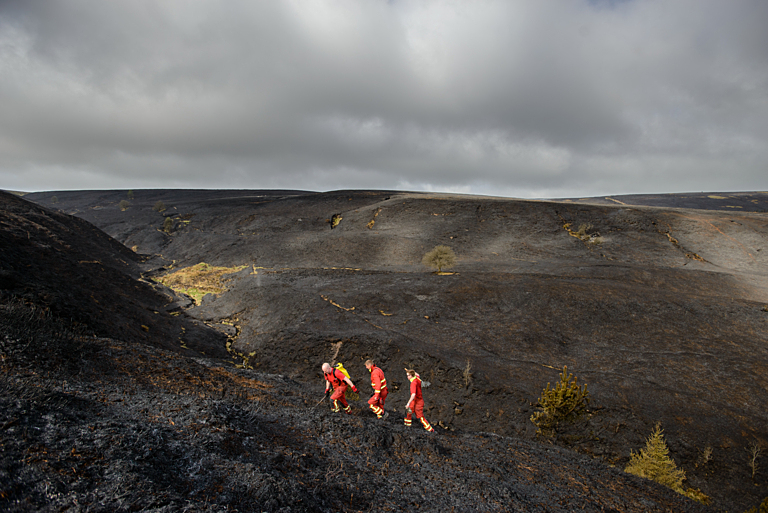 Firefighters work to tackle a large moorland fire near Buxton in the Peak District. Derbyshire, England. 3rd May 2025. Credit: Alastair Johnstone-Hack / Climate Visuals
Just four of the 24 TV and radio programmes monitored by Climate News Tracker covered the European State of the Climate 2025 report on the day it was published, and only two examined its findings in any depth.
Published annually by the European Centre for Medium-Range Weather Forecasts (ECMWF) and the World Meteorological Organization (WMO), the report is one of the most comprehensive assessments of Europe’s climate.
The 2025 edition documented a series of record-breaking climate impacts across Europe.
A record three-week heatwave affected sub-Arctic Fennoscandia, with temperatures near and within the Arctic Circle exceeding 30°C.
Wildfires burned more than one million hectares across Europe, the largest area on record.
Sea surface temperatures across Europe reached record levels, while 86% of the region experienced at least “strong” marine heatwaves.
The report found that at least 95% of Europe experienced above-average temperatures in 2025, reinforcing its position as the world’s fastest-warming region.
Climate News Tracker monitored 19 TV and five radio programmes across the BBC, ITV, Channel 4, Channel 5 and Sky News to assess how the report was covered on the day of publication.
Key Findings:
- 20 of the 24 monitored programmes gave the report no coverage.
- Four programmes mentioned the report, but only two examined its findings in any depth.
Who covered the report and how
The report received no coverage in 20 of the 24 programmes monitored.
Two programmes, Sky News Today with… and 5 News at 5, included only brief news in brief segments.
Sky News mentioned record temperatures, wildfires and marine heatwaves before moving on. 5 News at 5 noted that Europe is warming faster than other continents and that the UK had experienced a record wildfire year.
The two programmes that went deeper were BBC Radio 4 Today and ITV Evening News.
BBC Radio 4 Today interviewed Dr Samantha Burgess, Deputy Director of the Copernicus Climate Change Service, covering the report’s headline findings, why Europe is warming faster than other regions and the role of renewable energy.
Burgess said Europe is on course to reach the 1.5C Paris threshold before the end of the decade, more than ten years earlier than anticipated when the agreement was signed.
ITV Evening News featured science correspondent Martin Stew using studio graphics to explain that Europe is warming twice as fast as the global average, linking wildfire and glacier loss to rising greenhouse gas emissions.
Stew explained that light coloured surfaces which once reflected heat are disappearing, causing more heat to be absorbed. This was illustrated with a clip from an interview with Dr Burgess talking about Europe becoming sunnier as sea ice, glacier ice and cloud cover are lost.
The piece ended with Europe’s renewable energy record, noting that solar and wind overtook fossil fuels in power generation last year, while scientists warned the pace of change remains too slow.
Both programmes treated the report as a major climate story, combining scientific explanation with concrete examples and longer term context.
Sky News also gave the report more detailed online coverage, highlighting UK specific findings including Britain’s hottest summer on record, record wildfire numbers and £800m in agricultural losses. It came alongside quotes from Dr Burgess and Hilary McGrady, head of the National Trust, who said that exceptional years are now becoming the norm.
The article also noted that solar power provided 12.5% of Europe’s electricity in 2025.
That only two of 24 programmes gave one of Europe’s most significant climate reports substantive coverage reflects a broader trend. Climate reporting across UK public service broadcasters fell by 12% in 2025 compared with 2024, the sharpest year on year decline of any topic tracked by Climate News Tracker.
Methodology
Climate News Tracker monitored 24 TV and radio programmes broadcast on 29 April 2026 across the BBC, ITV, Channel 4, Channel 5 and Sky News.
Each was manually reviewed to assess whether it covered the European State of the Climate 2025 report, and if so, to what depth.
Related Insights
Nepal floods: Climate change featured early, but faded as coverage turned to the human toll
Climate concern rises to highest level since 2024 after summer of extreme weather
Almost two-thirds of adults in Great Britain now see climate change and the environment as an important issue the UK faces, as record-high summer heat, drought and wildfires brought the impacts of a changing climate closer to home.
Heatwaves, wildfires, emergency alerts and Rosebank: Where did public service media join the dots?
TV and radio were much more likely than online and social media to connect a week of heatwaves, wildfires, emergency alerts and North Sea drilling. Drilling received the least coverage, but was the topic most consistently linked to climate change.

Register here to be the first to receive insights from Climate News Tracker.