Climate coverage reached its highest level of 2026 during two June heatwaves, but the rise was short-lived. Climate News Tracker’s latest quarterly analysis finds extreme weather remained the only story that consistently broke through, while other climate stories with clear news pegs received little attention.

How people got their news shaped what they learned about the June heatwave
While warnings and health advice came through reliably everywhere, the climate science behind the heat was explained least often in the formats younger audiences rely on most for their news.
by Rosie Frost (Journalism Insights Analyst), Alina Sandauer (Content Analyst), Dr Lissa O’Reilly (Content Analyst) & Odyssée Ferrillo (Content Analyst)
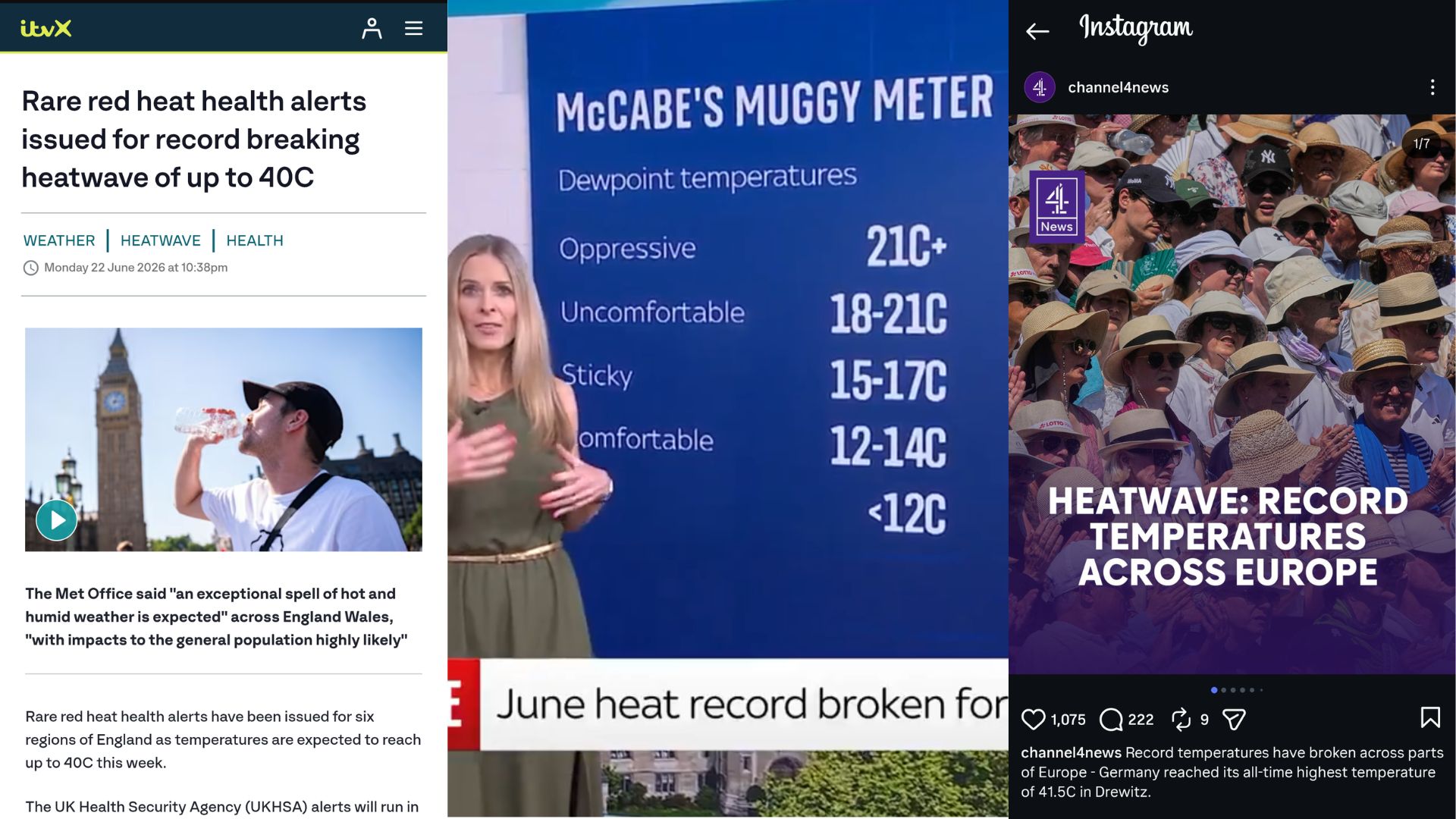
Across nine days in June, the heatwave was one of the biggest stories in the UK. It broke temperature records, triggered only the second-ever red extreme heat warning, and put hospitals and ambulance services under sustained pressure.
Climate News Tracker analysed 188 TV and radio programmes, 167 online news articles and 269 Instagram and TikTok posts published by the UK’s major public service media organisations during the June heatwave. Each platform was analysed separately before comparing what audiences received.
BBC and Sky News live blogs were also tracked as part of the online analysis, but were assessed differently from standalone articles and are not included in the comparisons below.
Despite those differences in volume and format, the same two elements of the story, warnings and health advice, turned up reliably everywhere it was told. Climate change did not travel nearly as consistently, and the formats where it appeared least are also where younger audiences are more likely to get their news.
Key findings:
- Climate change was linked to the heatwave in 62% of TV and radio programmes, 24% of online articles, and 16% of Instagram and TikTok posts covering the heatwave.
- Heat warnings featured in 87% of TV and radio programmes, 57% of online articles, and 38% of Instagram and TikTok posts.
- Health impacts appeared at relatively similar rates across all three: 56% of TV and radio programmes, 48% of online articles, and 42% of Instagram and TikTok posts.
- Weather presenters became the main climate communicators on TV, radio and social media.
- Public voices were the single largest category of quoted sources across TV and radio, ahead of scientists, politicians, or health experts.
Audiences were much less likely to encounter climate context on social media (16%) than on TV and radio (62%), with online news articles sitting between the two (24%). Heat warnings followed a similar pattern, featuring in 38% of Instagram and TikTok posts, 57% of standalone online articles, and 87% of TV and radio programmes which covered the heatwave. Health impacts, by contrast, appeared relatively consistently across all three platforms, at 42%, 48%, and 56% respectively.
Climate change featured at very different rates across formats
Climate change was linked to the heatwave in 62% of TV and radio programmes. Broken down into individual formats, that is 66.7% of radio programmes covering the heatwave, linking it to climate change, compared with 61.1% of TV programmes.
It was also linked in 24% of online articles and 16% of Instagram and TikTok posts.
On TV and radio, most of that coverage linked climate change substantively rather than in passing. The two formats diverged in how deeply they explored that link.
On radio, 54.2% of climate-linked coverage treated the connection as a substantive story in its own right, with a further 29.2% covering it as a substantive segment within a wider piece, and only 16.7% reduced it to a passing reference.
On TV, the pattern was closer to reversed, with just 29.9% of climate-linked coverage being a substantive story, 45.5% being a substantive segment, and 24.7% being a passing reference.
Online and social coverage still carried the heatwave extensively, but the causal explanation, that this heat was made more likely and more intense by human-caused climate change, appeared far less often in a short online article or an Instagram or TikTok post than in a TV or radio segment.
This means climate change featured more than twice as often on TV and radio as in online articles, and more than three times as often on TV and radio as on Instagram and TikTok.
Who covered the heatwave?
Weather presenters featured in 54% of TV and radio programmes covering the heatwave, and 40% of identified presenters on Instagram and TikTok. Online, weather desks were attributed in just 9% of standalone articles.
On TV and radio, weather presenters were often the primary source of climate science content, going well beyond the forecast to explain concepts like Arctic amplification and humidity-driven heat stress. TV and radio diverged when broken down by format. Weather presenters featured in 59.5% of TV programmes covering the heatwave, compared with 33.3% of radio programmes.
Climate or science specialists showed a narrower gap, appearing in 23.0% of TV programmes and 27.8% of radio programmes covering the heatwave, meaning radio was, proportionally, more likely to bring in a dedicated climate voice even as it relied less on weather presenters overall.
On Instagram and TikTok, weather teams were responsible for close to a third of all climate-linked posts, more than any other desk.
On TV and radio, weather presenters were often the primary source of climate science content, going well beyond the forecast to explain concepts like Arctic amplification and humidity-driven heat stress. On Instagram and TikTok, weather teams were responsible for close to a third of all climate-linked posts, more than any other editorial desk. Online, regional newsrooms produced the large majority of coverage instead.
What external voices were featured in coverage?
Beyond who presented the coverage, Climate News Tracker also tracked what external voices were featured. Across the 162 TV and radio programmes covering the heatwave, there were 434 individual external voices.
Members of the public were the single largest category, featuring 56 times (12.9% of all external voices) and appearing in 38 programmes, close to a quarter (23.5%) of all TV and radio coverage.
People directly impacted by the heat, such as those affected by travel disruption or hospital pressure, were the next largest group, featuring 49 times (11.3%) across 31 programmes.
Scientists and health experts, the two categories most directly tied to explaining the heatwave itself, featured far less often. Health experts featured 44 times (10.1%) across 30 programmes, and were overwhelmingly represented by doctors specifically: 29 of the 30 programmes that featured a health expert featured a doctor, meaning a doctor appeared in 17.9% of all TV and radio programmes covering the heatwave.
Scientists featured just 25 times (5.8%) across 21 programmes, fewer than half as often as members of the public.
Standalone online articles showed a similar pattern.
Across 298 external voices coded in online coverage, business people were the most common, featuring 39 times (13.1%), ahead of people directly impacted by the heat (33 times, 11.1%) and members of the public (30 times, 10.1%).
Scientists featured 19 times (6.4%), and health experts, including doctors, featured 15 times (5.0%), of which 3 were doctors specifically, meaning both specialist categories again trailed well behind the public-facing and lived-experience voices.
Where TV and radio coverage was led by members of the public, online coverage was led by business voices, a difference that may reflect online’s greater reliance on regional newsrooms, whose reporting often runs through local business impact.
Warnings travelled further than explanations
Heat warnings featured in 87% of TV and radio programmes covering the heatwave.
Radio programmes were more likely to mention a heat warning at all, featuring in 91.7% of radio programmes covering the heatwave against 85.7% on TV.
In comparison, 57% of standalone online articles and 38% of social posts featured heat warnings.
Explanations of these warnings were inconsistent across all of the formats. We were generous with what we counted as an explanation, including even brief attempts to explain the warning alongside fuller explanations.
On TV and radio, 53% of programmes that mentioned a warning made some attempt to explain it, meaning 47% did not. Radio was less likely to explain what that warning meant. 46.2% of radio programmes that mentioned a warning made some attempt to explain it, compared with 54.8% on TV.
In online articles, 26% of those that mentioned a warning explained it. Instagram and TikTok coverage was not coded for explanation depth in the same way and so cannot be compared.
Warnings featured roughly twice as often on TV and radio as on Instagram and TikTok, and were roughly twice as likely to be explained on TV and radio as in online articles.
Health impacts held steady across formats
Unlike the climate link, coverage of health impacts stayed relatively consistent regardless of format, with 56% of TV and radio programmes, 48% of online articles, and 42% of social posts covering some kind of health consequences from the heat.
The most common health impacts referenced in online articles were cold water shock, heat exhaustion and heat stroke, and risk to children, older people and other vulnerable groups.
On TV and radio, the most common were heat exhaustion and heat stroke, risk to vulnerable groups such as older people and children, dehydration, and cold water shock.
On Instagram and TikTok, coverage focused more on how humidity affects the body’s ability to cool down, heat stroke, and difficulty sleeping through tropical nights, alongside recurring pieces on hospital and ambulance strain, and heat risks to babies and outdoor workers.
Health impacts appeared at almost the same rate across all three formats, only slightly less often on Instagram and TikTok than on TV, radio or online.
What does this tell us about heatwave coverage?
This series of analyses suggests that someone who only encountered the June heatwave through one format would have come away with a broadly consistent understanding of the health risks and official warnings, whether they were watching a TV bulletin, reading a news website or scrolling through Instagram or TikTok..
What varied was whether they also came away understanding why heatwaves like this are becoming more frequent and more intense. That explanation appeared most often on TV and radio, less frequently in online news, and least often on the social platforms where younger audiences increasingly get their news.
That distinction matters because news consumption is changing.
The Reuters Institute’s Digital News Report 2026 found Instagram has become the biggest social platform for news among 18 – 24-year-olds, reaching 42% of that age group, while younger generations now favour social media and video networks over television, which remains the main source of news mainly for people aged 45 and above.
It also mattered who was telling the story. On TV, radio and social media, weather presenters frequently became the main communicators of climate science, weaving explanations into routine forecasts and weather updates. Online, those specialist voices were far less prominent, with climate context more likely to depend on whether it was included by a regional reporter within a wider news story.
The findings suggest that the same heatwave was explained differently depending on where audiences encountered it.
Each platform had distinct strengths: TV and radio provided the most climate context, online news offered greater space for depth and practical reporting, while social media prioritised health advice and immediate impacts. As audiences increasingly consume news across multiple platforms, understanding how editorial choices shape public understanding becomes just as important as measuring how much climate coverage there is.
Related Insights
Climate coverage hit a 2026 high, but only because of two heatwaves
What audiences learned about Europe’s July wildfires on Instagram, TikTok and YouTube
Climate News Tracker analysed how UK public service media organisations covered Europe’s July 2026 wildfires across Instagram, TikTok and YouTube. Audiences consistently received vivid reporting on the destruction caused by the fires, but were far less likely to hear why conditions for them are becoming more common.
How news websites and live blogs covered the June 2026 heatwave
Heat warnings dominated, but articles were far less likely to explain what those warnings meant or connect the record temperatures to climate change.

Register here to be the first to receive insights from Climate News Tracker.