Climate News Tracker’s Q3 analysis finds that climate-related terms appeared in nearly half of monitored UK TV and radio news programmes in August, before falling in September. Meanwhile, rising coverage of energy costs was not matched by an increase in mentions of renewable energy.

Record heat, record warnings: What UK TV and radio told audiences during the June heatwave
The June 2026 heatwave brought record temperatures, only the second-ever red extreme heat warning, and unprecedented pressure on hospitals and emergency services. Climate News Tracker analysed 188 TV and radio programmes to understand what information audiences received as the story unfolded.
by Rosie Frost (Journalism Insights Analyst), Alina Sandauer (Content Analyst), Dr Lissa O’Reilly (Content Analyst) & Odyssée Ferrillo (Content Analyst)
Part of Climate News Tracker’s June 2026 Heatwave Coverage Series.
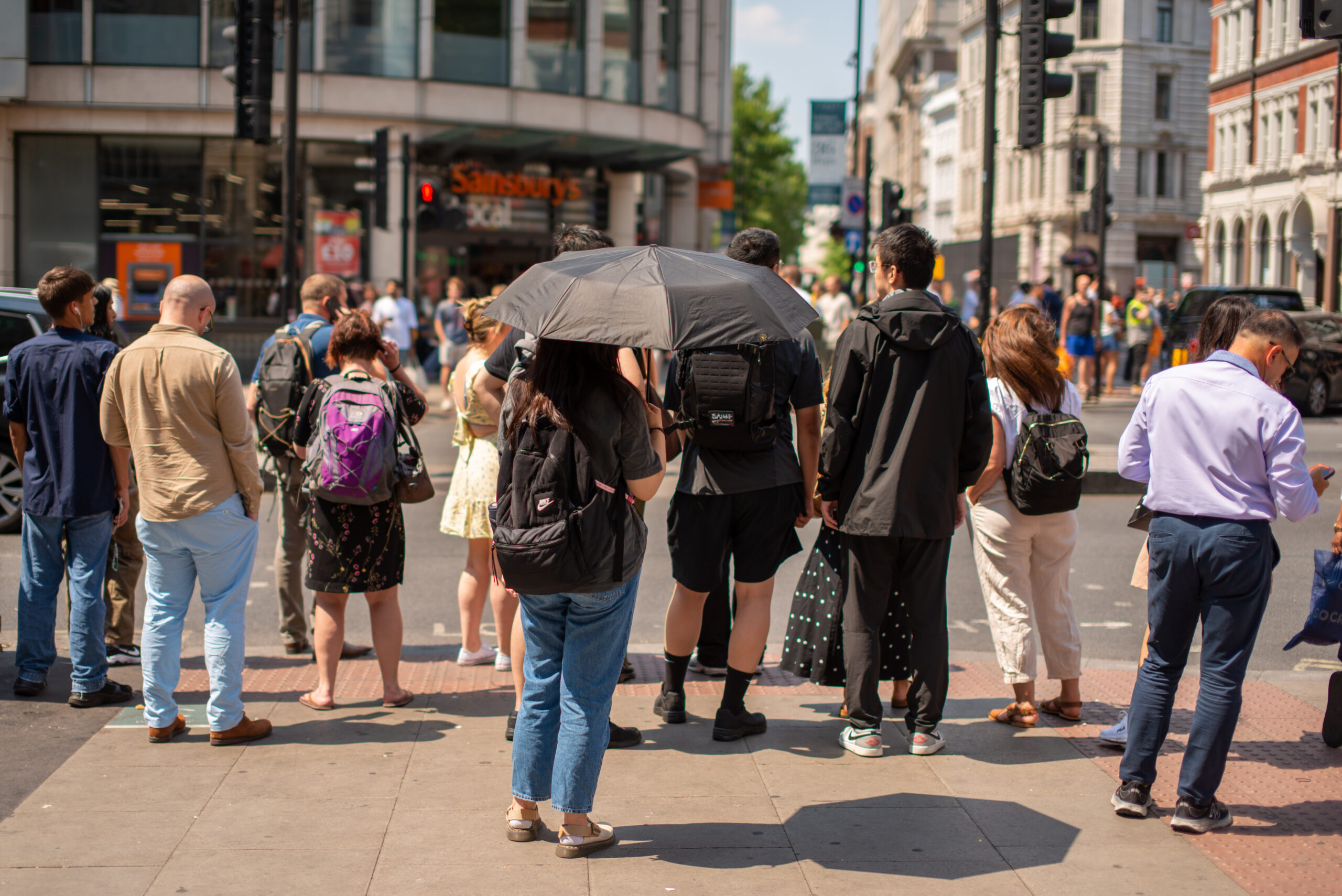
The June 2026 heatwave broke UK June temperature records on three consecutive days and triggered only the second-ever red extreme heat warning. Hospitals declared critical incidents, and the London Ambulance Service recorded its busiest day for life-threatening emergencies.
Broadcast news responded with extensive coverage, but what audiences were told evolved significantly as the week progressed.
Part of Climate News Tracker’s June 2026 Heatwave Coverage Project
This analysis examines how UK public service TV and radio news covered the June heatwave. Related analysis looks at how broadcasters covered the story on Instagram and TikTok, and how it was reported online.
Key findings:
- 86% of programmes covered the heatwave, with 79% giving it substantive treatment.
- 62% of programmes covering the heatwave linked it to climate change.
- 87% mentioned at least one heat-related warning.
- 56% covered health impacts.
- Weather presenters featured in 54% of programmes covering the heatwave.
- Climate correspondents appeared in 24%.
- Fossil fuels were mentioned in 18% of programmes covering the heatwave.
How was the heatwave covered?
Across the nine days, 162 of 188 programmes monitored covered the heatwave in some form. Coverage peaked between 23 and 25 June. On 23 June, all 23 programmes monitored covered the story.
As the event intensified, so did the climate link. On 20 June, just 18% of programmes made the connection. By 22 June, as the Met Office first announced the red warning, it had risen to 70%. By 23 June, it reached 96%, and on 24 June, as red warnings came into force, 90% of programmes linked the heatwave to climate change.
The 50th anniversary of the 1976 June temperature record provided a recurring editorial frame, and several programmes used the comparison to convey the scale of what was happening.
On BBC Breakfast on 25 June, Professor Tim Woollings of the University of Oxford explained that 2026 used “fairly ordinary” weather patterns for a heatwave, but that climate change had “fuelled the system” to break records that those same conditions would not have broken in 1976.
As conditions began to ease from 27 June, the figure dropped to 27%. On 28 June, it fell to zero. The pattern mirrors Climate News Tracker’s findings during the May heatwave: the climate connection rises with the temperature and falls away as it drops.
Health impacts were covered in 56% of programmes covering the heatwave. But the picture changed significantly over the nine days. On 20-21 June, as the heatwave built, fewer than one in four programmes covered health consequences. When red warnings came into force on 24 June, health impacts featured in 90% of programmes.
The types of health impacts covered shifted and broadened as the week progressed. Early coverage focused largely on vulnerable groups like the elderly, care home residents, and those with underlying conditions.
By 24 June, when red warnings came into force, coverage had widened to include risks to healthy people, water safety deaths, ambulance service pressure, and school and workplace conditions.
A distinctive thread that emerged across several programmes was infrastructure failure as a health story. Hospital cooling systems breaking down, MRI scanners going offline, and cancer treatment machines overheating were covered as direct threats to patient care rather than background operational details.
Who covered the heatwave?
The June heatwave was covered by a much broader range of editorial teams than the May heatwave. As the impacts spread beyond weather to health, transport, education and infrastructure, specialist correspondents became increasingly visible alongside the more common presenters and general reporters.
Weather presenters became the main climate explainers
Weather presenters featured in 54% of all programmes covering the heatwave, making them the most consistent contributors across the nine days. In many cases, they became the primary source of climate science explanation rather than simply delivering the forecast.
Several went well beyond forecasting, explaining Arctic amplification, jet stream behaviour and the relationship between humidity and heat stress.
Laura Tobin on Good Morning Britain on 24 June, for example, said that “heat will kill more people than any other extreme weather in the UK”, while Becky Mantin closed her forecast on ITV Evening News on 22 June by saying: “The world is warming faster than we can adapt to it and that really is a very sobering thought.”
Climate and health specialists were more visible
Climate and science correspondents featured in 24% of programmes covering the heatwave, compared with just 4% during the May heatwave, although the two events differed in both scale and duration.
Justin Rowlatt and Jonah Fisher appeared most frequently on the BBC. Rowlatt explicitly attributed the heatwave to climate change as early as 21 June, while Fisher identified fossil fuels as the driver on 25 June.
Sky News science editor Tom Clarke produced detailed reports explaining dew point temperatures and why the heatwave felt more oppressive than the summer of 2022. On Channel 4 News, technology and science editor Siobhan Kennedy used thermal imaging to illustrate how London pavements had reached around 60°C while reporting on the impacts on health and infrastructure.
Health correspondents also became a regular feature as the week progressed. BBC correspondents Sophie Hutchinson, Dominic Hughes and Nikki Fox, alongside ITV’s Fergus Walsh, reported on hospital critical incidents, ambulance service pressures, equipment failures and the health consequences of prolonged extreme heat.
Who did audiences hear from?
As the heatwave intensified, the range of voices featured in coverage broadened beyond weather presenters and meteorologists to include health professionals, scientists, teachers, care workers and politicians.
Across the 162 programmes that covered the heatwave, 434 external contributors appeared.
Members of the public were the most common voices, appearing 56 times, typically through vox pops at beaches, railway stations and lidos. A further 49 appearances came from people directly affected by the heatwave, including parents whose children’s schools had closed and residents living in overheating homes.
Health experts became far more prominent than during the May heatwave, featuring 44 times. Most were practising doctors or GPs explaining the risks of extreme heat and the growing pressure on health services.
Scientists appeared 25 times, with contributors including Samantha Burgess of the Copernicus Climate Change Service and Professor Friederike Otto of Imperial College London, helping audiences understand why the heatwave was breaking records.
Education and social care professionals appeared 34 times, describing classrooms reaching 33 to 34°C and the challenges of protecting vulnerable residents with dementia during prolonged periods of extreme heat.
Politicians were featured 29 times. London Mayor Sadiq Khan discussed the capital’s preparedness on Channel 4 News, while Education Secretary Bridget Phillipson was questioned on Today about climate change and school infrastructure.
Many other political interviews during the week focused on unrelated issues, including Prime Minister Keir Starmer’s resignation. In several cases, there were opportunities to explore questions of climate adaptation or resilience in the context of the heatwave with leaders of all parties, but these were not pursued.
Heatwave visuals
The visual story of the heatwave evolved alongside the editorial focus. Early coverage was dominated by beaches, parks, lidos and people enjoying the sunshine. As the impacts intensified, those images gave way to hospitals, railway stations, care homes, schools and wildfires.
Weather graphics became increasingly detailed throughout the week. Maps showing amber and red warning areas featured in almost every programme that covered the story substantively, helping audiences track the changing risks.
On Sky News Breakfast on 25 June, meteorologist Kirsty McCabe introduced “McCabe’s Muggy Meter,” an explainer graphic showing dewpoint temperatures on a scale running from “Dry” at below 12°C through “Comfortable,” “Sticky,” and “Uncomfortable” to “Oppressive” at 21°C and above.
We’ve had the warmest June day on record and provisionally the warmest night too. But why does this heatwave feel so much worse than back in 2022 when we saw over 40 degrees in the UK? Here comes the science bit with @kirstymccabe pic.twitter.com/OgfMGJozQX
— Sky News Weather (@SkyNewsWeather) June 25, 2026
Several programmes also used thermal imaging to illustrate the intensity of the heat in urban centres. Channel 4 News showed London pavements reaching 60°C
And archive footage from the summer of 1976 also appeared across several programmes, providing a visual comparison with Britain’s previous record June heatwave and reinforcing the scale of what audiences were experiencing.
How were heat warnings communicated?
Across the nine days, 141 programmes mentioned at least one warning. Those warnings came from different systems, including Met Office weather warnings, graded amber, red, and yellow, covering the meteorological event itself, and UKHSA heat-health alerts, a distinct system focused specifically on health and social care impacts and their knock-on effects for transport, food, water, energy, and businesses.
At various points, several different warnings were in force simultaneously and were not always distinguished from one another in coverage.
There were some cases, however, where weather presenters explicitly explained the difference between the Met Office weather warning and the UKHSA heat-health alert, clarifying that they were separate systems from separate bodies.
View this post on Instagram
On Good Morning Britain on 24 June, Laura Tobin distinguished between the Met Office red extreme heat warning and the UKHSA red heat-health alert, explaining that they were issued by separate bodies and meant different things. On the heat-health alert, she said: “Red means that anybody, regardless of whether you’re vulnerable, every single person in the country is now at risk from these extreme high temperatures.”
Just over half (53%) of the programmes that mentioned a warning attempted some form of explanation. We were generous in how we defined an attempt, including programmes where a presenter briefly noted “dangers to health” or “a risk to life.” This means that in 47% of programmes that referenced a warning, no explanation was offered at all.
Amber warnings, which had been in force since 20 June, were rarely explained in detail. That may partly reflect familiarity, as amber warnings are issued more frequently and audiences may be assumed to know what they mean.
Across the three days that both the Met Office red extreme heat warning and the UKHSA red heat-health alert were in force (24, 25, and 26 June), explanation rates were higher but still varied.
The red warning, issued for only the second time ever, appears to have carried more editorial weight and prompted more detailed explanation, even if that explanation was still inconsistent.
Why does this matter
The June heatwave demonstrated that the science is more likely to feature when the impact of climate change is more extreme, immediate and visible. The editorial opportunity, as the story evolves, is to sustain that context beyond record temperatures and warnings, helping audiences understand not only what is happening today, but what it means for future extreme weather and the choices society faces.
Methodology
Climate News Tracker used keyword searches across transcripts to identify programmes that mentioned the heatwave, using the terms: heatwave, heat wave, record temperature, rising temperature, extreme heat and heat.
This identified 162 programmes across the BBC, ITV, Channel 4, Channel 5 and Sky News between 20 and 28 June 2026. Each programme was manually reviewed in full.
Each programme was classified according to whether it gave the heatwave substantive coverage, treated it as a substantive segment within a broader programme, gave it a passing mention, or gave it no coverage at all.
A substantive story was defined as one in which the heatwave was the primary subject of the item. It would not exist without it. A substantive segment was defined as one in which the heatwave was a significant theme explored in meaningful detail, but sat alongside other topics or drivers. A passing mention was defined as a brief, incidental reference that would not materially change the item if removed. Programmes were discounted where keyword matches referred to heatwaves in other countries or in entirely unrelated content.
Each programme was coded for whether it linked the heatwave to climate change, to what depth, cited official warnings and covered health impacts. External voices were identified and categorised by type through manual review of transcripts.
This analysis measures whether climate change, fossil fuels, warnings and health impacts were mentioned or discussed. It does not assess the accuracy or quality of every reference.
Programmes reviewed
BBC Breakfast, Today, Good Morning Britain, Breakfast with…, Sky News Today with…, BBC News at One, The World at One, ITV Lunchtime News, PM, 5 News at 5, 5 News Weekend, Newshour with…, BBC News at Six, ITV Evening News, Channel 4 News, The World Tonight, The World this Weekend, BBC News at Ten, ITV News at Ten, Newsnight, Sunday with Laura Kuenssberg, Question Time, Newsround, Six O’Clock News, Broadcasting House, Westminster Hour, Peston, Jeremy Vine, The Cathy Newman Show, Sunday Morning with Trevor Phillips, The World with Yalda Hakim, The Wrap and UK Tonight.
Related Insights
Climate coverage peaked during summer heatwaves, then fell as public concern remained high
Andy Burnham’s energy pledges reported as a cost of living story, not a climate one
As energy bills head for their biggest rise in four years, climate change featured for seven seconds in Andy Burnham’s conference speech and in none of the 22 standalone online articles analysed.
Nepal floods: Climate change featured early, but faded as coverage turned to the human toll
TV, radio, and online coverage were more likely to link climate change to the Nepal floods than social media, with the strongest connections in the first two days before attention shifted to casualties, rescue efforts and immediate impacts.

Register here to be the first to receive insights from Climate News Tracker.