Almost two-thirds of adults in Great Britain now see climate change and the environment as an important issue the UK faces, as record-high summer heat, drought and wildfires brought the impacts of a changing climate closer to home.

Nepal floods: Climate change featured early, but faded as coverage turned to the human toll
TV, radio, and online coverage were more likely to link climate change to the Nepal floods than social media, with the strongest connections in the first two days before attention shifted to casualties, rescue efforts and immediate impacts.
by Rosie Frost (Journalism Insights Analyst), Alina Sandauer (Content Analyst), Dr Lissa O’Reilly (Content Analyst), Sam Cardwell (Content Analyst) & Odyssée Ferrillo (Content Analyst)
25 September 2026
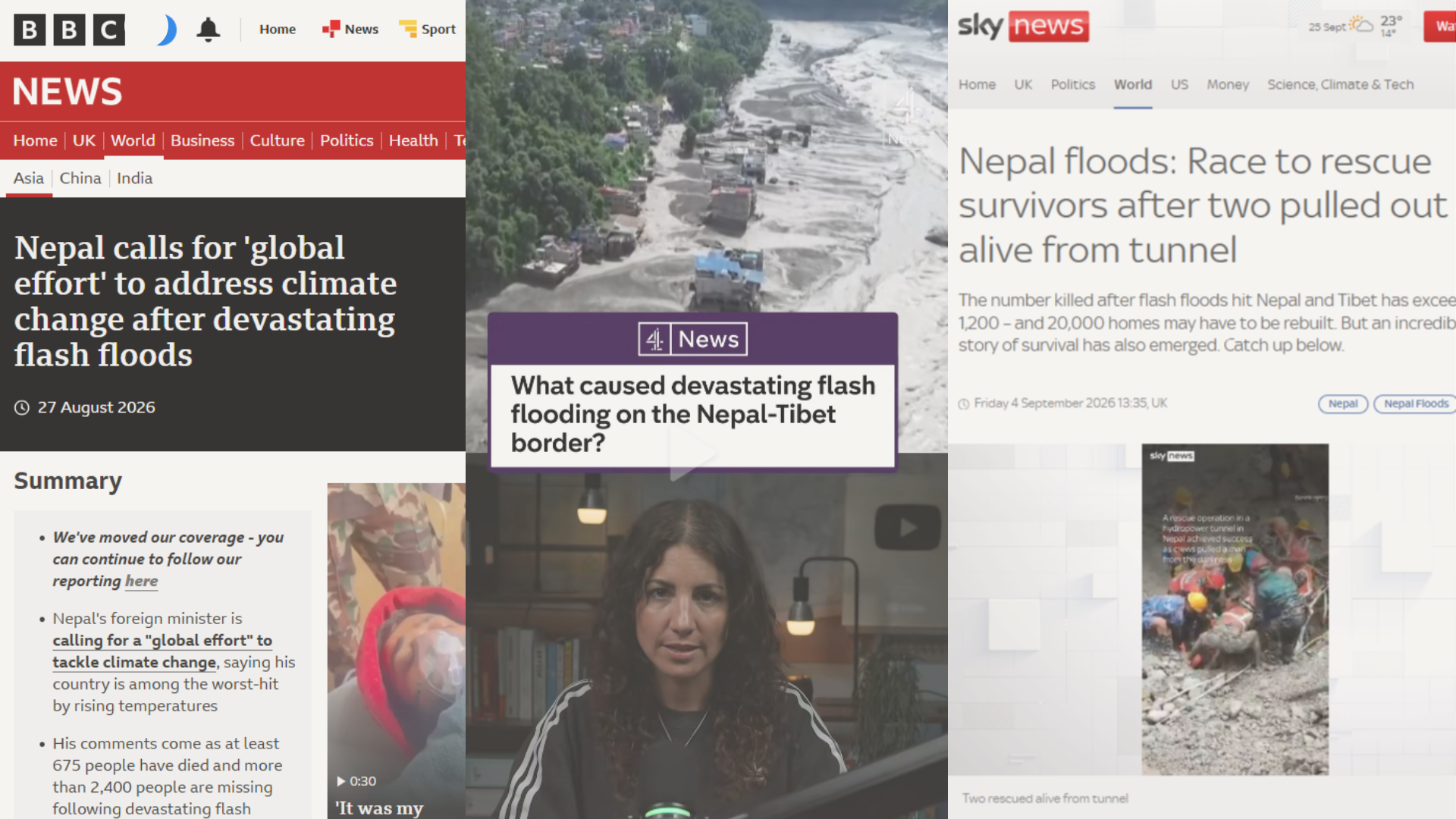
Credit: Sky News / BBC News / Channel 4 News (TikTok)
On 26 August 2026, a large mass of ice and rock collapsed on the Nepal–Tibet border, triggering flash floods that swept down the Trishuli River. The floods destroyed bridges, roads and hydropower infrastructure in Nepal’s Rasuwa and Nuwakot districts and on the Tibetan side of the border.
Early reports attributed a seismic signal from the event to an earthquake. Subsequent scientific analysis found that the signal was generated by the ice-and-rock collapse itself, rather than by a tectonic earthquake.
The event also raised a wider question about how the disaster was framed. To what extent did coverage connect the collapse and resulting floods to climate change? The disaster occurred in a region where glaciers are losing ice rapidly, with the rate of ice loss across the Hindu Kush Himalaya roughly doubling since 2000. While climate change has not been directly attributed as the cause of this specific event, scientists say that warming is changing the high-mountain environment and increasing the risk of related hazards.
That distinction matters: explaining how warming is changing the environment in which these hazards occur is not the same as attributing this particular collapse to climate change.
Climate News Tracker analysed TV and radio programmes, online articles, Instagram posts and TikTok posts published between 26 August and 6 September 2026. We looked at how the disaster was explained and reported, including its causes and impacts, the use of scientific sources and external voices, and whether coverage connected the floods to climate change and fossil fuels.
Key Findings
-
-
- Climate change was mentioned in 23% of TV and radio coverage and 22% of online coverage, but in only 6% of Instagram and 5% of TikTok posts.
- Climate change linkage was strongest during the first two days, before coverage shifted towards rescue efforts, casualties and other immediate impacts.
- 7% of climate-linked coverage explicitly named fossil fuels as a driver of climate change.
- Missing persons and deaths dominated impact coverage, while displacement and economic impacts received much less attention.
- Impacted people were the most common external voice across all four platforms.
-
How often were the floods linked to climate change?
Climate change was mentioned in 23% of TV and radio coverage (43 of 183) and 22% of online articles (15 of 69). On social media, the proportion was considerably lower: 6% of Instagram posts (7 of 111) and 5% of TikTok posts (7 of 141) linked the disaster to climate change.
The pattern suggests climate change was present in coverage but not a dominant frame across the full reporting period. It was also more prominent in TV, radio and online news coverage than on social media.
Climate framing peaked early, then gave way to the human angle
Climate framing was strongest during the first two days of coverage, particularly on TV, radio and online. TV and radio coverage reached 55% on 27 August, the second day of the disaster. Coverage included “what caused this” explainers and early comments from scientists linking the glacier collapse to climate change.
Online coverage peaked a day earlier, on 26 August, when 67% of articles linked the event to climate change. Climate change was generally included as background on Himalayan glacier melt rather than as the main focus, and two of the four articles explicitly cautioned that it was “too soon” or “too early” to link the specific event to climate change.
These examples show that providing climate context did not necessarily mean attributing the specific collapse to climate change. Coverage could explain the wider changes taking place in the Himalayas while remaining cautious about the role of warming in this individual event.
Instagram and TikTok peaked much later than the other platforms, on 2 September, when 17% of Instagram posts and 20% of TikTok posts linked the disaster to climate change. Earlier, on 27 August, both platforms carried some climate framing at much lower rates: 13% of Instagram posts (3 of 24) and 13% of TikTok posts (4 of 31).
Two examples from 27 August illustrate the range of this coverage. A Channel 4 News TikTok explicitly raised whether a warming Himalaya, accelerated by fossil fuel burning, could make events like this more likely. The Channel 4 post was the earliest of the five fossil-fuel references identified across the dataset.
A Sky News TikTok video also included an interview with geoscientist Simon Cook about the possible causes of the collapse.
@skynews
From 28 August onwards, climate-linked coverage generally declined as reporting increasingly focused on rescue efforts, casualties and other immediate developments. TV and radio coverage fell from 35% on 28 August to 12% by 30 August, reaching 0% on 4 and 5 September. Online coverage fell to 7% on 28 August, then moved unevenly rather than staying near zero, rising to 33% on 30 August and 17% on 4 September before falling to 0% by 5 September. Instagram and TikTok fell to 10% and 6% on 28 August, respectively, and stayed at zero for most of the following week.
A secondary rise occurred on 3 September, when climate-linked coverage reached 38% on TV and radio and 43% online. This coincided with the Nepalese government’s focus on climate injustice, providing a new climate-related news hook. Instagram and TikTok did not show the same increase on that day. Instead, they rose the day before, on 2 September (17% and 20% respectively), and again on 4 September (10% each).
Overall, climate change was most visible when coverage had a clear reason to explain the wider context, first around questions about the cause of the disaster and later around Nepal’s focus on climate injustice. As reporting concentrated on the immediate human consequences, the climate dimension became much less prominent.
Fossil fuels rarely featured in the climate explanation
The connection between climate change and fossil fuels was much less common. Of the 72 items across TV and radio, online, Instagram and TikTok that linked the disaster to climate change, 5 (7%) explicitly named fossil fuels, or the burning of oil, gas or coal, as a driver of climate change.
A Channel 4 News post on both TikTok and Instagram on 27 August asked whether “a warming Himalayas, accelerated by the burning of fossil fuels” contributed to the collapse.
@c4news
On 30 August, an online ITV Hub article cited scientists discussing rising temperatures caused by “human activities such as burning oil, gas and coal.”
An ITV Lunchtime News broadcast on 3 September explicitly linked “the burning of fossil fuels” to extreme weather and climate change, alongside Nepal’s call for accountability from “rich polluting countries”.
Also on 3 September, a BBC News online article quoted Joanna Lumley at a vigil in Blackheath, where she referred to “the fossil fuels we burn and the plastic waste in the sea” as making the world “a sicker place and a weaker place”.
Live blogs rarely turned to climate
Live blogs provide a further indication of how the climate angle changed as the disaster developed. Sky News and the BBC each ran live blogs covering the event continuously. Sky News’s ran from 26 August to 4 September across 358 posts, and the BBC across three successive pages from 26 to 31 August, totalling 382 posts.
Across the two outlets, 740 live-blog posts were logged, of which 31 (4%) linked the floods to climate change. This was considerably lower than the proportion found in TV and radio programmes or standalone online articles.
Climate mentions in both live blogs peaked on 27 August, matching the wider pattern seen in TV and radio coverage. Sky News carried 10 climate-linked posts out of 74 (14%) that day, while the BBC’s page carried 6 out of 94 (6%).
After this point, climate references in both blogs fell to zero or one post per day for most of the remaining period. The live blogs therefore followed the same broader pattern where climate framing was concentrated early in the disaster and became much less common as coverage continued.
What impacts were most frequently mentioned?
Missing persons and deaths dominated coverage across all platforms. They were mentioned most often on TV and radio, followed by online news, with lower levels on Instagram and TikTok.
On TV and radio, missing persons were mentioned in 98% of programmes and the death toll in 96%. Infrastructure and hydropower damage was also common (73%), while displacement (22%) and economic impacts (5%) received much less attention.
Online coverage followed a similar pattern, with missing persons mentioned in 93% of articles, the death toll in 88%, and infrastructure and hydropower damage in 64%. Displacement and economic impacts were mentioned in only 7% and 4% of articles, respectively.
On Instagram and TikTok, missing persons and damage were again the most common impacts, although at lower rates. Social media posts also often referred to deaths without giving a specific death toll. Displacement and economic impacts were rarely mentioned on either platform.
Overall, the coverage focused heavily on the immediate human consequences of the disaster, particularly missing people and deaths, while displacement and economic impacts received considerably less attention.
Impacted people were the most common external voices
People directly affected by the disaster were the most common external voice across every platform. They accounted for 50% of external voices on TV and radio, 35% online, 76% on Instagram and 68% on TikTok.
Who audiences heard from also varied geographically. We looked at whether impacted people and climate scientists featured in coverage were based in Nepal or elsewhere, to understand how often audiences heard directly from people and expertise rooted in the country affected.
TV and radio predominantly featured Nepal-based impacted people, with 189 compared with 53 based elsewhere.
Online coverage showed the reverse, with 59 impacted people based outside Nepal compared with 25 based in Nepal. Instagram was more evenly split, with 20 Nepal-based voices and 16 based outside Nepal, while TikTok featured 22 based outside Nepal and 13 Nepal-based voices.
On TV and radio, 33 of the 53 global impacted voices were from the UK.
Climate scientists were less numerous and showed a different geographic pattern. TV and radio featured 17 climate scientists based outside Nepal and nine Nepal-based scientists, while online coverage included eight based outside Nepal and 11 Nepal-based.
Instagram featured four global climate scientists and no Nepal-based scientists, while TikTok featured three global climate scientists and no Nepal-based scientists.
Broadcast coverage drew particularly heavily on Nepal-based impacted people. The geographic pattern for climate expertise was more mixed: TV and radio relied more on scientists based outside Nepal, while online coverage featured slightly more Nepal-based scientists. Instagram and TikTok featured no Nepal-based climate scientists in the posts analysed.
Climate justice framing was limited
Climate injustice was another relatively limited aspect of the coverage. This was defined as framing that contrasted Nepal’s relatively low contribution to global emissions with its high exposure to climate impacts.
This framing appeared in 7% of TV and radio programmes (13 of 183), 4% of online articles (3 of 69), 2% of Instagram posts (2 of 111) and 1% of TikTok posts (2 of 141).
Climate compensation was mentioned even less frequently. It appeared in 7% of TV and radio programmes (12 of 183), but in none of the online articles. It was mentioned in 1% of Instagram posts (1 of 111) and 1% of TikTok posts (1 of 141).
A similar question in Canadian coverage
A recent analysis by Tara Mahoney of CBC’s coverage of the Nepal disaster looks at many of the same questions as this Climate News Tracker analysis: how clearly the disaster was connected to climate change, its causes and wider inequalities.
Mahoney found that an 11-minute About That segment explained the glacier collapse and flooding in detail, but mentioned climate change only briefly at the end. She argues that the coverage missed the links between fossil-fuel-driven warming, changing mountain environments and the unequal impacts of climate change.
Our analysis suggests similar gaps appeared across UK public service media, but also shows how they changed over the course of the story. Climate context was strongest while journalists were explaining what had happened, then became less prominent as reporting shifted towards the human consequences.
Some early UK coverage also showed that providing climate context did not require directly attributing the collapse to climate change. Journalists could explain the wider changes taking place in the Himalayas while explicitly acknowledging uncertainty about the role of warming in this specific event.
Read: How do climate communication gaps emerge? Why CBC’s Nepal disaster coverage matters
What did audiences learn?
Audiences were most likely to encounter climate context while journalists were attempting to explain what had happened.
During the first two days, TV, radio and online coverage frequently introduced climate change and Himalayan glacier loss as part of the wider context around the collapse. Importantly, some coverage also made clear the limits of what scientists could say, explaining that it was too early to attribute this specific event directly to climate change.
But that context became less visible as the story developed. Reporting increasingly focused on missing people, deaths, rescue efforts and damaged infrastructure. People directly affected by the disaster became the most common external voices across every platform.
Even where climate change remained part of the story, the context often stopped there. Only five of the 72 climate-linked items explicitly identified fossil fuels as a driver of climate change. Climate injustice and compensation were also relatively uncommon, while relatively little coverage explored the mechanisms connecting warming with changes in high-mountain environments.
A World Weather Attribution assessment published after our study period helps illustrate why that distinction matters. It found that human-caused warming has contributed to changes in the high-mountain environment that can increase the risk of tragedies like these, while the precise contribution of climate change to this particular collapse remains difficult to establish.
Dr Ben Clarke of Imperial College London said that while the disaster was not an extreme weather event, “the fingerprints of climate change are still clear to see in long-term changes”.
The coverage therefore faced a difficult but important distinction: explaining the climate conditions surrounding the disaster without claiming that climate change caused an event scientists had not directly attributed to it. Early coverage showed that this could be done. The challenge was sustaining that context once attention moved to the human toll.
Methodology
Climate News Tracker used keyword searches to identify TV, radio and online coverage published between 26 August and 6 September 2026 relating to the floods in Nepal.
Keywords used to identify relevant coverage included variations of:
- Flood (“flood,” “flooding,” “floods”)
- Nepal (“Nepal”)
- Tibet (“Tibet,” “Tibetan”)
- Glacier (“glacier,” “glaciers”)
- Himalaya (“Himalaya,” “Himalayan,” “Himalayas”)
- Landslide (“landslide,” “landslides”)
All items returned were reviewed in full to establish whether they met the inclusion criteria and whether they linked the floods to climate change.
Social media posts across TikTok and Instagram were reviewed manually in full without a keyword search.
Television and radio coverage was drawn from BBC (including Radio 4 and the World Service), ITV, Channel 4, Channel 5 and Sky News flagship programmes.
Online coverage was drawn from BBC, ITV Hub, Channel 4 and Sky News websites.
Social media accounts varied by platform, reflecting the accounts available on TikTok and Instagram.
Items were coded for whether they:
- linked the floods to climate change;
- discussed the cause of the floods;
- named scientific sources or reports;
- discussed impacts from the floods;
- raised the disproportion between Nepal’s low emissions and its high exposure to climate impacts;
- mentioned climate compensation; and
- included external voices.
External voices were recorded where a person or organisation was quoted, interviewed or otherwise featured as a source.
An item was classified as linking the floods to climate change if it explored how climate change could affect the floods, their causes or their impacts. It did not need to explicitly attribute the cause of the floods to climate change.
Impacts were coded across five categories: missing persons, deaths, infrastructure and hydropower damage, displacement and economic impacts.
Live blogs were treated as a separate category of online coverage. The analysis counted individual live-blog posts rather than standalone online articles. It covered Sky News’s live blog from 26 August to 4 September and three successive BBC live-blog pages published between 26 and 31 August.
The analysis measures whether and how the floods were linked to climate change, and how impacts, causes, scientific sources and external voices were covered. It does not assess the accuracy or quality of individual references.
Percentages for TV and radio, online articles, Instagram and TikTok are calculated against the total number of items analysed within each category. Live-blog percentages are calculated against the total number of individual live-blog posts analysed.
Related Insights
Climate concern rises to highest level since 2024 after summer of extreme weather
Heatwaves, wildfires, emergency alerts and Rosebank: Where did public service media join the dots?
TV and radio were much more likely than online and social media to connect a week of heatwaves, wildfires, emergency alerts and North Sea drilling. Drilling received the least coverage, but was the topic most consistently linked to climate change.
Extreme weather brought the fossil fuel transition into UK news, but rarely as the main story
Heatwaves provided the main opportunity to connect extreme weather with the move away from fossil fuels, but the transition was more often a secondary part of the story and was rarely discussed on TikTok.

Register here to be the first to receive insights from Climate News Tracker.