Climate News Tracker’s Q3 analysis finds that climate-related terms appeared in nearly half of monitored UK TV and radio news programmes in August, before falling in September. Meanwhile, rising coverage of energy costs was not matched by an increase in mentions of renewable energy.

Only on Jackdaw decision day did climate change feature prominently in North Sea drilling coverage
Climate scientist voices rarely feature across six months of North Sea drilling coverage leading up to the Jackdaw approval. Politicians dominate the airwaves.
by Rosie Frost (Journalism Insights Analyst), Alina Sandauer (Content Analyst), Dr Lissa O’Reilly (Content Analyst), Sam Cardwell (Content Analyst) & Odyssée Ferrillo (Content Analyst)
05 November 2026
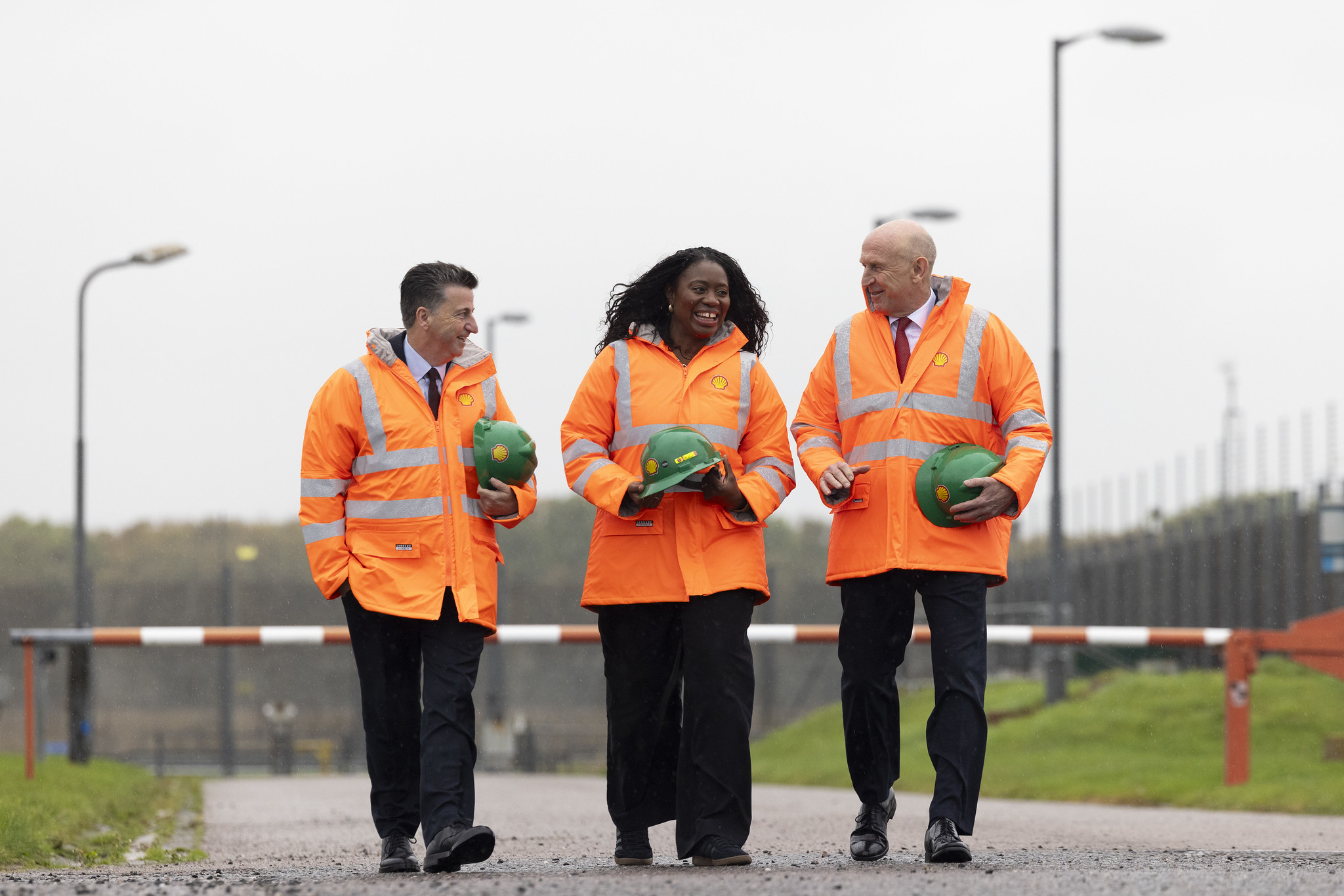 John Healey, Chancellor of the Exchequer; Miatta Fahnbulleh, Energy Secretary; and Douglas Alexander, Scottish Secretary at the St Fergus gas terminal on the day Jackdaw was approved. “Chancellor John Healey visits St Fergus Gas Plant” by HM Treasury, CC BY-NC-ND 4.0
When the UK government approved the Jackdaw gas field on 21 October 2026, climate change featured prominently across TV, radio and online coverage. This contrasted with the six months before the decision, when fewer than half of the TV and radio programmes and around a third of the online articles about North Sea drilling we analysed linked it to climate change.
In the months leading up to the decision, North Sea drilling featured in coverage of a Scottish by-election, a change of Prime Minister and a summer of record heat and wildfires. Yet climate change was often missing from these stories.
To understand how coverage changed over this period, we analysed how UK public service media organisations covered Jackdaw and Rosebank on TV, radio and online between 14 April and 14 October 2026. We also examined coverage of the Jackdaw decision on 21 October across TV, radio, online articles, live blogs and short-form social video.
Key Findings
- Political events drove most coverage peaks: Three of the four TV and radio peaks followed political developments. Coverage was most likely to link drilling to climate change when decisions about the fields themselves led the news.
- Politicians were the most common voices: They accounted for 59% of external voices on TV and radio before the decision and 71% on decision day. They also made up 80% of people quoted online before the decision and 72% on decision day.
- Climate links increased on decision day: 92% of TV and radio programmes covering Jackdaw linked the decision to climate change, compared with 47% of relevant programmes in the pre-decision sample. Online, the share rose from 31% to 60%.
- A UN warning brought climate change into the story: Six of the 25 TV and radio programmes on the day reported the Jackdaw decision alongside a UN Environment Programme warning, published the same day, that global warming would overshoot 1.5°C.
- Climate change was used to argue both for and against drilling: Opponents highlighted the climate crisis, while supporters argued that North Sea gas had a lower carbon footprint than imports.
What drove the peaks in coverage of North Sea drilling?
TV and radio coverage had four clear peaks during the six months. Online coverage had no comparable peaks once duplicate and irrelevant articles were removed, so we examined online reporting on the TV and radio peak days and on several additional dates when online coverage initially appeared to peak.
Three of the four peaks were driven by political events. The first, on 19 June, followed the Aberdeen South by-election, which Kemi Badenoch called a “referendum on oil and gas”.
The second peak, on 25 June, came as Andy Burnham emerged as the frontrunner to replace Keir Starmer as Prime Minister, prompting speculation about who would become Chancellor. Coverage reported Rachel Reeves backing Burnham’s leadership bid and signalling support for North Sea drilling.
The third and longest peak ran from 17 to 21 July. Reports that Burnham planned to announce support for more North Sea drilling in his first week as Prime Minister prompted discussion of what this could mean for Jackdaw and Rosebank.
Donald Trump’s comments on the North Sea featured in coverage during all three of these peaks.
The fourth peak, on 17 August, was driven by the fields themselves, as programmes reported on the close of the Rosebank consultation and the decision ahead.
Without peaks of its own, online coverage followed the same political stories, with drilling usually one item among several. Articles focused on the fields appeared around the close of the Rosebank consultation and in the days before the decision.
Who featured in coverage before the decision?
Politicians were the most common external voices, making up 71 of the 120 voices on TV and radio (59%) and 79 of the 99 quoted online (80%). On TV and radio, energy industry voices made up 11%, campaigners 8% and academics 6%. Kemi Badenoch was the most frequently heard individual on TV and radio, and Andy Burnham the most quoted online.
The range of voices widened when developments concerning the fields themselves led the news. On 17 August, one programme featured six external voices, from Adura, Offshore Energies UK, the University of Aberdeen, Uplift, Greenpeace UK and the Stop Rosebank campaign.
Did coverage before the decision link drilling to climate change?
Across the selected dates we analysed before the decision, 47% of relevant TV and radio programmes and 31% of relevant online articles linked North Sea drilling to climate change. The analysis focused on periods when coverage was most prominent, rather than all coverage throughout the six months. The link was strongest when decisions about the oil and gas fields themselves led the news.
On 19 June, 4 of 14 programmes (29%) made the link, rising to 20 of 49 (41%) around Burnham becoming Prime Minister and all 12 on 17 August. Online, all seven articles mainly about the fields linked them to climate change, compared with two of the 22 where drilling was part of a wider story.
During the political peaks, programmes often raised climate change through Labour’s 2024 manifesto, which said new licences “would accelerate the climate crisis”. On 18 July, Labour MP Rachael Maskell said “carbon-based fuels must stay in the ground because we are in the midst of a climate crisis”, pointing to “the consequences we’re seeing this summer”.
Climate change was also used as an argument for drilling. On BBC One’s Sunday with Laura Kuenssberg on 19 July, Kemi Badenoch said the UK was importing oil and gas from countries that drill “in a dirty fashion”, and that domestic production had a lower carbon footprint.
How was the Jackdaw decision covered on the day?
We analysed the decision day separately from the six-month sample, examining all relevant coverage on 21 October across TV, radio, online articles, live blogs and short-form social video.
Jackdaw was the lead story across TV and radio on 21 October, with 25 TV and radio programmes covering the decision, 15 online articles, three live blogs and 28 posts on TikTok and Instagram.
Programmes reported the decision mainly through what Jackdaw would and would not deliver. Ministers said it would bring energy security, gas to homes and businesses by the end of the month and tax revenue for a new £2 billion Energy Wealth Fund to invest in clean energy. Coverage consistently reported that it would not lower bills, which Energy Secretary Miatta Fahnbulleh and Chancellor John Healey both accepted in interviews.
Politics shaped much of the coverage. Prime Minister’s Questions featured widely, with Kemi Badenoch thanking Andy Burnham “for finally approving” Jackdaw, and Energy Minister Michael Shanks’s Commons statement was carried live. Donald Trump’s post urging the UK to “go full blast” and “take down the costly and ridiculous windmills” was widely reported.
Who featured in coverage of the Jackdaw decision?
Politicians made up 107 of the 151 external voices on TV and radio (71%) on the day of the Jackdaw decision. Campaigners made up 9% and energy industry voices 9%.
Miatta Fahnbulleh was the most frequently heard voice, appearing in 15 programmes, followed by Andy Burnham in 13 and Kemi Badenoch in 11. Areeba Hamid of Greenpeace UK appeared in five and Neil McCulloch of Adura in four.
Interviewers challenged voices on both sides of the decision. Ministers were pressed on whether it would bring down energy bills, on the upcoming Rosebank decision and on their past positions on drilling in the North Sea.
Fahnbulleh was challenged with the New Economics Foundation’s argument that “new fossil fuel projects increase the overall global supply of fossil fuels”. She previously led the organisation.
In an interview for ITV’s Peston, recorded at Shell’s St Fergus gas terminal in Aberdeenshire, political editor Robert Peston asked Chancellor John Healey whether the UK would allow more oil drilling in the North Sea after Jackdaw. Healey said the new Energy Wealth Fund would use North Sea oil and gas revenues to invest in clean energy. When Peston put it to him that he would “have to approve Rosebank”, Healey replied that it was a matter for the Energy Secretary.
@itvpolitics Will the UK allow more oil drilling in the North Sea after approving drilling at the Jackdaw gas field? ITV News Political Editor Robert Peston asks Chancellor John Healey. Watch the full interview tonight on @ITV News ♬ original sound – ITV Politics
Opponents of the Jackdaw decision were most often challenged with the argument that the UK would use gas anyway. Hamid was asked why the UK should buy Norwegian gas rather than produce its own, and Green MP Carla Denyer was presented with a More in Common poll showing 55% support for drilling at Jackdaw and Rosebank.
Online, politicians made up 41 of the 57 voices quoted (72%), campaigners 9% and energy industry voices 5%.
Did coverage of the decision link Jackdaw to climate change?
On 21 October, 23 of the 25 TV and radio programmes (92%) linked the Jackdaw decision to climate change, compared with 47% of programmes before the decision. The two programmes that did not link carried brief items on the political reaction and the following day’s newspaper front pages.
Two things brought climate change into the coverage.
The UN Environment Programme published a report that day warning that global warming would exceed 1.5°C. Six programmes reported it alongside the Jackdaw decision, including two that interviewed UNEP Executive Director Inger Andersen, who said the next question for the UK was its plan for renewables.
On BBC News at Six, climate editor Justin Rowlatt described the timing as “awkward”, coming on the day of the UN warning and ahead of the COP climate summit, and reported that the government had acknowledged the decision could “damage its reputation as a global climate leader”.
The decision was also linked to this summer’s heatwaves, wildfires and drought in 10 programmes. In three morning interviews, Fahnbulleh cited the extreme weather as evidence of climate change, saying “climate change is here”.
As in the previous six months, climate change was also used as an argument in favour of Jackdaw. Supporters and several correspondents said North Sea gas had lower emissions than imported liquefied natural gas, with one correspondent putting the difference at “about 15%”.
Correspondents also set out the scale of emissions involved, with in-studio explainers and on-screen graphics showing estimates for Jackdaw of 24 to 36 million tonnes of CO2 over its lifetime, against around 250 million tonnes for Rosebank.
Nine of the 15 online articles (60%) linked the decision to climate change, compared with 31% before the decision. As before, the link depended on the focus of the article.
All eight articles mainly about Jackdaw linked it to climate change, including an explainer comparing its emissions with US and Norwegian imports. Of the seven where Jackdaw featured in coverage of the Budget, standing charges or the Energy Wealth Fund, one linked it to climate change.
On social video, 20 of 28 posts on TikTok and Instagram (71%) linked the decision to climate change. Most posts covered several themes, so the following counts overlap. Of the 28 posts, 13 said Jackdaw would not lower bills, 13 discussed what it meant for jobs, 10 mentioned tax revenue and 10 compared home-grown and imported gas.
Some posts put the climate question up front. A BBC News Instagram reel asked what the decision meant for the climate, setting the government’s case that Jackdaw would provide energy security, jobs and heat for millions of homes against campaigners’ view that it was the wrong decision after the hottest summer on record.
View this post on Instagram
It noted Adura’s claim that the field’s production emissions were lower than other gas fields, but explained that burning the gas is the main source of emissions, and that the UN had warned the world was off track on cutting emissions, raising the risk of extreme weather.
How did live blogs cover the Jackdaw decision?
We analysed three live blogs on 21 October. The BBC ran a live blog dedicated to the Jackdaw decision. Sky News covered it in two daily live blogs, one on politics and one on personal finance, which covered a range of stories, so we counted their posts about Jackdaw. Live blogs are updated through the day with short posts, so we counted posts rather than whole articles. Across the three, 52 of the 107 posts about Jackdaw (49%) linked it to climate change.
In the BBC’s live blog, 34 of 64 posts linked the decision to climate change. It quoted a wide range of people, including politicians from the main parties, energy companies, unions, charities and campaign groups, academics, the UN Environment Programme and members of the public.
It also checked claims made elsewhere in the day’s coverage. Adura, the company that operates Jackdaw, said its gas produced similar emissions to gas piped from Norway. Analysis in the live blog found that, once processing and transport were included, Jackdaw’s emissions were higher. Another post reported that the government’s own decision document said approving Jackdaw could harm the UK’s reputation as a climate leader, giving this “moderate adverse weight”.
Sky News’s politics live blog carried 42 posts about Jackdaw through the day, 18 of which linked it to climate change.
It included an analysis arguing that “if you ignore our warming climate”, the decision “makes total sense”, before setting out that Jackdaw holds 36 million tonnes of carbon and that the cost of coping with a warmer climate would make the impacts of war, a weak economy and rising bills “look almost trivial”.
The personal finance live blog mentioned Jackdaw in one post, which did not link it to climate change.
Methodology
Climate News Tracker analysed coverage of Jackdaw and Rosebank on TV, radio and online news between 14 April and 14 October 2026. TV and radio transcripts from 33 flagship news programmes on the BBC, ITV, Channel 4, Channel 5 and Sky News were searched for “Jackdaw”, “Rosebank”, “drilling” and “North Sea”.
Online articles from BBC, ITV, Channel 4 and Sky News were collected using the same keyword search.
We identified peaks in TV and radio coverage and in online news separately. A TV and radio peak was a day when 40% or more of programmes mentioned a search term, and an online peak was a day with six or more articles, around three times the daily average. Online articles were deduplicated, and peaks were checked manually for false positives, such as weather forecasts mentioning the North Sea.
We selected four TV and radio peaks where the search terms referred to the oil and gas fields: 19 June, 25 June, 17 to 21 July and 17 August. No day met the threshold for an online coverage peak once duplicates and false positives were removed. We therefore analysed online articles published on the four TV and radio peak dates, as well as on 22 June and 13 to 14 October, when online coverage had initially appeared to peak.
For each, we examined what drove the coverage, which external voices featured and whether North Sea drilling was linked to climate change, either directly or by connecting it to climate impacts such as extreme weather. References to net zero alone were not counted. External voices were people heard directly on TV and radio, or quoted directly in online articles. We also analysed coverage of the Jackdaw decision on 21 October across TV and radio, online articles, live blogs and short-form social video, using the same questions.
Percentages are of programmes or articles that referred to the fields or North Sea drilling once false positives were removed, and voice percentages are of all external voices. For live blogs, we counted posts about Jackdaw. Social video covered 28 posts on TikTok and Instagram from the BBC News, Sky News, ITV News, ITV Politics, Channel 4 News and Good Morning Britain accounts.
Related Insights
Climate coverage peaked during summer heatwaves, then fell as public concern remained high
Andy Burnham’s energy pledges reported as a cost of living story, not a climate one
As energy bills head for their biggest rise in four years, climate change featured for seven seconds in Andy Burnham’s conference speech and in none of the 22 standalone online articles analysed.
Nepal floods: Climate change featured early, but faded as coverage turned to the human toll
TV, radio, and online coverage were more likely to link climate change to the Nepal floods than social media, with the strongest connections in the first two days before attention shifted to casualties, rescue efforts and immediate impacts.

Register here to be the first to receive insights from Climate News Tracker.