Heatwaves provided the main opportunity to connect extreme weather with the move away from fossil fuels, but the transition was more often a secondary part of the story and was rarely discussed on TikTok.

World Cup heat warnings struggle to break through UK broadcast news agenda
With the World Cup less than a month away, two major publications warned of dangerous heat risks for players. Just two of the 68 UK news programmes monitored covered either story.
by Rosie Frost (Journalism Insights Analyst), Alina Sandauer (Content Analyst) & Dr Lissa O’Reilly (Content Analyst)
22 May 2026

With England’s World Cup squad now announced and Scotland’s already confirmed, attention is turning to the tournament less than a month before kick-off. But as Climate News Tracker has found, the heat risks these players are facing have received very little coverage on UK broadcast news. Just 2 of the 68 programmes monitored between 13 and 15 May, when two major publications raised serious concerns about player safety at this summer’s tournament, covered the issue at all.
On 13 May, an open letter signed by more than 20 medical, public health, and climate scientists argued that FIFA’s current heat guidelines are inadequate and could put players at risk of serious harm. The same week, a report by World Weather Attribution (WWA) found that human-induced climate change has significantly increased the likelihood of dangerous heat conditions at World Cup venues compared to 1994, the last time the tournament was held in the United States.
More than 50 current and former professional players have also written to FIFA following the report, warning that heat makes it impossible to play with the same intensity and calling on the governing body to update its heat-stress framework before the tournament begins.
Together, the publications make a detailed, evidence-based case that heat at this summer’s World Cup is a serious and climate-driven public health story. England manager Thomas Tuchel has spoken candidly about the challenge, raising the possibility of keeping substitutes in the dressing room during games to shield them from the heat until they are needed. “Suffering is one of the headlines for this World Cup,” he told journalists last summer.
The tournament, hosted across the United States, Canada, and Mexico, begins on 11 June.
Climate News Tracker tracked 68 individual programme broadcasts, spanning 26 distinct TV and radio news titles across BBC, Channel 4, Channel 5, ITV, and Sky News, broadcast on 13, 14, and 15 May, to assess how these two warnings were covered.
Key findings
- Just two of the 68 programmes broadcast between 13 and 15 May covered either the letter or the report warning about heat stress at the 2026 World Cup.
Who covered the World Cup heat risk story?
Of the 68 programmes analysed, only two covered warnings about dangerous heat conditions at the 2026 FIFA World Cup.
BBC Radio 4’s Today programme ran a correspondent-led piece on 14 May in which sports correspondent Katie Gornall reported on the open letter and the risks of heat stress at the tournament.
The piece noted that around a quarter of matches are likely to be played in high-risk heat conditions and that scientists consider FIFA’s current measures outdated. It also reported calls for cooling breaks of at least six minutes rather than the current three. FIFA said scheduling had been planned with climate conditions in mind.
Sky’s Breakfast with… on 15 May picked up the story during a newspaper review, with presenters discussing the Daily Mirror’s coverage of the World Weather Attribution findings. The conversation touched on the implications for players, drew comparisons to the decision to move the Qatar World Cup to winter, and raised broader questions about when major sporting events should take place.
Twice as many programmes identified through our World Cup search covered Madonna, Shakira and BTS being named as headliners for the first-ever halftime show.
Online Coverage
Both BBC Sport and Sky News also published online articles covering the story.
View this post on Instagram
BBC Sport ran a detailed piece on the open letter, reporting on scientists’ calls for longer cooling breaks and clearer postponement protocols. It also included comment from signatories of the letter and briefly noted the findings of the WWA report.
The BBC Sport piece was written by Katie Gornall, who also reported the story for BBC Radio 4’s Today.
This year’s World Cup could see hazardous heat and humidity for players and fans at around a quarter of games, academics warnedhttps://t.co/itWkEqnBZP
— Sky News (@SkyNews) May 14, 2026
Sky News led with the WWA report, noting the risk of dangerous heat and humidity at around a quarter of games and including reaction from FIFPRO’s medical director.
What was missed?
The open letter, published on 13 May, was signed by more than 20 medical, public health and climate scientists, including academics from UCL, the University of Sydney and the London School of Hygiene and Tropical Medicine.
The signatories called on FIFA to align its protocols with those of players’ union FIFPRO, which recommends intervention at a Wet Bulb Globe Temperature of 26°C and postponement above 28 °C. FIFA’s current threshold is 32°C.
They also called for cooling breaks to be extended from three minutes to at least six, and identified fossil fuel sponsorship as a structural conflict of interest with FIFA’s stated commitment to player welfare.
View this post on Instagram
Climate change is set to be a big player at the FIFA #WorldCup this summer, as new research from World Weather Attribution reveals how the risk of extreme heat has spiked since the last time the tournament was held in the US.
Separately, the report by WWA found that human-induced climate change has substantially increased the likelihood of dangerous heat conditions at World Cup venues compared to 1994, the last time the US hosted the tournament.
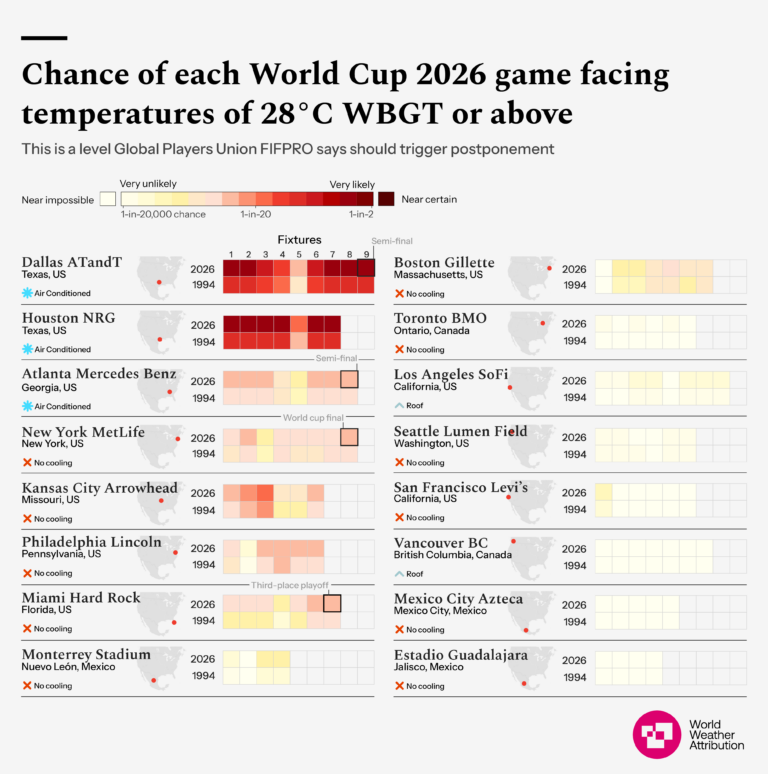
Overview of the likelihoods of all games in a 2026 climate and a 1994 climate. Credit: World Weather Attribution.
Researchers estimated that 26 games could be played in conditions at or above FIFPRO’s 26°C intervention threshold, up from 21 in 1994.
Despite offering a clear climate and public health angle tied to one of the world’s biggest sporting events, the two warnings received almost no UK broadcast coverage, less than a month before the tournament begins.
Methodology
Climate News Tracker tracked 68 individual programmes spanning 26 TV and radio news titles across the BBC, Channel 4, Channel 5, ITV and Sky News between 13 and 15 May 2026.
A programme was counted as covering the story if relevant keywords appeared in the transcript, and manual review confirmed the coverage was related to heat stress at the World Cup.
The five broadcasters’ websites were also searched using Onclusive with the same keywords to capture any online-only coverage.
Search terms included: climate change, FIFA, World Cup, player safety and climate.
Related Insights
Extreme weather brought the fossil fuel transition into UK news, but rarely as the main story
Newsrooms needn’t fear climate is ‘boring’. Audiences don’t think so
Former Head of the BBC Newsroom and Controller of BBC World Service Mary Hockaday argues that extreme weather is giving journalists clear opportunities to explain the climate story, while new audience research suggests the public wants that context. by Mary Hockaday (Former Head of the BBC Newsroom and World Service controller) News crews have been […]
Half the UK public want news reports to explain climate link to extreme weather
As heatwaves, wildfires and drought dominate summer headlines, new Climate News Tracker research finds half the UK public want news organisations to explain the climate link when scientific evidence supports it, while a further 20% want climate change central to every extreme-weather story.

Register here to be the first to receive insights from Climate News Tracker.