Heatwaves provided the main opportunity to connect extreme weather with the move away from fossil fuels, but the transition was more often a secondary part of the story and was rarely discussed on TikTok.

The UK’s drought became a bigger news story once it was declared, but not a better-explained one
Coverage surged after drought was officially declared, but online and social video audiences received far less explanation of its causes and long-term solutions.
by Rosie Frost (Journalism Insights Analyst), Alina Sandauer (Content Analyst), Dr Lissa O’Reilly (Content Analyst), Sam Cardwell (Content Analyst) & Odyssée Ferrillo (Content Analyst)
The Environment Agency declared drought across seven areas of England on 29 July, after months of unusually dry weather and mounting pressure on water supplies.
The declaration changed the news story almost immediately. Nearly half of all the social videos Climate News Tracker analysed during July were published on or after 29 July, just three days of the 31-day study period. News organisations also became much more likely to explicitly describe conditions as a “drought”.
But greater attention did not necessarily bring greater explanation. Coverage often focused on low rainfall, heat, hosepipe bans and the immediate effects of dry conditions, while giving audiences much less information about climate change, water management or how the UK could adapt to increasing drought risk.
Climate News Tracker analysed online articles, live blogs, Instagram, TikTok and YouTube Shorts from UK public service media organisations throughout July, alongside a snapshot analysis of TV and radio coverage during the period of most intense reporting, to understand not just how drought was covered, but what audiences were likely to learn from that coverage.
Key Findings
- Climate context was much more common online than on social video. 34% of online articles linked the drought to climate change, compared with 13% of short-form social videos.
- The official declaration transformed coverage. 44% of all social videos analysed during July were published on or after 29 July.
- Most coverage did not explain what type of drought was occurring, even as use of the word “drought” increased sharply after the official declaration.
- Water management was largely missing from explanations of the causes. It featured in 9% of online articles that explained causation and none of the social videos that did so.
- Solutions were overwhelmingly short-term. Hosepipe bans appeared in 57% of online articles and 93% of social videos that discussed solutions.
- Drought was frequently covered alongside heatwaves and wildfires rather than covered in its own right.
Can drought be linked to climate change?
Drought is harder to attribute to climate change than some other forms of extreme weather, and the strength of the link varies by region.
World Weather Attribution guidance for journalists places the UK and western and central Europe in a lower-confidence category for directly linking individual drought events to climate change. The Met Office similarly notes that there are currently no UK attribution studies clearly showing that human-caused climate change has altered the risk of drought events. But that does not mean climate change is absent from the story. UK climate projections point towards drier summers, particularly in southern England, while higher temperatures increase the amount of moisture lost from soils and plants. Climate change can therefore worsen conditions associated with drought even when an individual event cannot confidently be attributed to it.
Our analysis did not assess whether individual climate links made by journalists were scientifically accurate. Instead, we measured whether coverage explicitly connected the drought or the conditions contributing to it with climate change.
Was drought linked to climate change?
Climate context was much more common in online coverage than on short-form social video.
Just over a third of online articles (34%) linked the drought to climate change, compared with 13% of social videos. For the latter, the rate was similar across platforms: 12% on Instagram, 12% on TikTok and 16% on YouTube Shorts.
Online coverage also varied sharply by editorial desk. Climate desk-led articles made the connection in 89% of cases, compared with just 9% of articles led by weather desks.
Some short-form social videos linked climate change only indirectly, to a related event rather than to drought itself. They did so in relation to wildfires, connecting climate change to conditions such as fire behaviour or hot, dry conditions. One connected man-made environmental issues to dry conditions endangering hedgehogs.
By contrast, two posts were a good example of where climate change and drought were put in the same frame with genuine explanation.
An Instagram reel from Good Morning Britain weather presenter Laura Tobin cited Imperial College London research showing climate change was worsening drought conditions across Europe.
View this post on Instagram
Sky climate reporter Victoria Seabrook also explained how successive heatwaves had drawn moisture from land and rivers, while noting that there is no clear attribution between climate change and drought events in the UK.
View this post on Instagram
Fossil fuels were absent from social video coverage. None of the posts connected the drought to fossil fuels as a driver of climate change or discussed moving away from them as part of the response. Online, 7% of articles made a link to fossil fuels.
How clearly was drought defined?
Most coverage used the word “drought” without explaining what it meant.
On short-form social video, 47% of posts referred to drought without specifying whether it was meteorological, hydrological or agricultural. A further 15% used “prolonged dry weather”, the classification used ahead of an official drought declaration, while 5% referred to a “flash drought”. More than a third (35%) did not use the word “drought” at all.
Online articles were even less likely to explain the term. 44% referred to drought without defining it and 31% did not use the word directly. Only 26% offered any explanation.
But a lack of definition did not always mean a complete lack of explanation. Among online articles that used “drought” without specifying a type, 78% still explained what was contributing to the dry conditions.
How was the cause of the drought explained?
When coverage explained why the drought was happening, it focused overwhelmingly on the weather.
Among online articles that explained the cause, 90% cited a lack of rainfall and 88% cited hot weather. Climate change featured in 32.5%, while water management issues were mentioned in just 9%.
Short-form social video offered a narrower explanation. Of the posts that discussed a cause, 92% cited a lack of rainfall and 20% cited hot weather. None identified climate change or water management as a cause.
The result was a largely weather-driven explanation of drought. Audiences were much more likely to hear about missing rain and high temperatures than the role of water management, including factors such as demand and leakage.
Both how drought was defined and how its cause was explained changed as July went on, most sharply around one date.
Official announcements changed the shape of coverage
The Environment Agency’s drought declaration on 29 July marked a clear turning point in coverage.
Before then, dry conditions were often folded into reporting on heatwaves and wildfires, or described as “prolonged dry weather”. Once drought was officially declared, news organisations became much more willing to use the word directly.
44% of all 111 videos analysed during July were published on or after 29 July, just three days of the 31-day study period. This suggests the official declaration provided the news hook that weeks of low rainfall and successive heatwaves had not.
The language changed too. Before the declaration, most social videos discussing dry conditions did not call them a drought. From 29 July, explicit use of the word rose sharply and became the dominant description.
Online coverage followed a similar pattern. Articles became much more likely to call the conditions a drought after the declaration, but explanation did not increase at the same rate. On 30 July, around 65% of articles referred to drought without explaining what it meant.
The declaration therefore changed both the volume and language of coverage, but not necessarily how well the drought was explained.
How was the drought covered on TV and radio?
Alongside our main analysis of standalone online articles, live blogs, and social coverage, we took a closer look at how the drought played out on TV and radio. To identify the period of most intense coverage, we analysed the frequency of drought-related keyword mentions across TV and radio programmes from 20 to 31 July and identified the days on which the percentage of programmes using at least one keyword peaked.
This pointed to 28 to 31 July as the period of most intense coverage, which we then reviewed in closer, manually coded detail.
Before the Environment Agency formally declared drought status across seven areas of central, eastern, and southern England on 29 July, references to dry conditions on TV and radio were scattered and mostly confined to weather forecasts.
Reporters described “parched” ground and unusually dry conditions, but the term “drought” itself was used sparingly, and more often applied to Spain, France, or Portugal than to Britain.
Coverage spiked sharply once the declaration was made, followed within days by a similar announcement for Wales. This became the clear high point of the monitoring period.
The declaration gave outlets an official status to report, a clear basis for calling UK conditions a “drought”, and a concrete news hook around which to build segments, on-location reports and interviews.
The proportion of programmes referencing at least one drought-related keyword rose substantially at this point, extending across nearly the full range of monitored programmes.
A wildfire breaking out shortly after the declaration gave the story a visual, human-interest anchor that kept coverage high for a further day, particularly on breakfast programming. By 31 July, coverage had begun to taper, with some monitored programmes pulling back to brief mentions even as conditions continued to worsen.
The format of coverage also shifted across this window. Early reporting leaned on on-location reports and packages, the standard formats for breaking news, while later coverage incorporated more interviews and multi-part “story sequence” segments, reflecting a shift from reporting the story as a live event to examining its causes and consequences.
Short-term, individual water-saving measures were a common frame
Where solutions were mentioned, they were overwhelmingly adaptation-focused. Adaptation refers to responses that help cope with drought conditions as they happen, such as building new water sources or improving supply infrastructure. Mitigation refers to action aimed at addressing the underlying causes of climate change, such as cutting emissions.
99% of online articles presenting a solution included an adaptation response, and 4% included a mitigation response. These categories aren’t mutually exclusive; a small number of articles included both, which is why the two figures add up to more than 100%.
Within that, two categories dominated. 57% of articles mentioning solutions mentioned hosepipe bans, and 31% mentioned individual reductions in water usage. Narrowing further, a quarter of articles mentioning solutions cited a hosepipe ban as the only solution offered, with nothing else discussed.
Short-form social video showed a comparable pattern. Where a solution appeared, it was adaptation-focused in every case, and 93% of posts mentioning a solution cited a hosepipe ban. Mitigation did not appear in a single coded post across Instagram, TikTok or YouTube Shorts.
What impacts did coverage focus on?
Coverage focused most heavily on the visible and immediate impacts of drought.
On short-form social video, water and infrastructure were the most common impacts, appearing in 38% of posts, largely through stories about hosepipe bans and reservoirs. Wildfires followed at 29%, while 25% discussed agriculture and food, including early harvests, struggling livestock and rising food prices.
Other consequences received much less attention. Wildlife, environmental damage and soil degradation featured less often, while economic and health and social impacts were among the least discussed. Almost three in ten social videos did not mention an impact at all.
One post explained how dry conditions can cause tree branches to fail and fall.
View this post on Instagram
Another explained “false autumn,” where the combination of drought and heatwave causes trees to shed leaves early, a visible environmental effect often mistaken for the start of the season.
View this post on Instagram
Online articles showed a similar emphasis. Water and infrastructure again came first, appearing in 44% of articles, followed by agriculture and food at 28% and wildfire risk at 24%. Economic impacts appeared in 15%, wildlife in 18% and health and social impacts in 14%.
Across both formats, audiences were therefore much more likely to encounter drought through its immediate, visible effects, such as dry reservoirs, struggling farms and wildfire risk, than through its wider economic or public health consequences.
Drought was often a secondary story
Drought was frequently covered through other extreme weather rather than as a story in its own right.
On short-form social video, 49% of posts connected drought or dry conditions with heatwaves and 29% with wildfires. Dry land, low rivers and reservoirs often provided context for more immediate and visual stories about extreme heat and fires.
Online coverage showed an even stronger overlap. 60% of articles linked drought to heatwaves and 33% to wildfires.
But appearing in the same story did not necessarily mean the relationship was explained. Only 24% of online articles connected drought to an increased risk of wildfires, suggesting the two were more often presented alongside each other than audiences were told how they were related.
The pattern suggests drought often reached audiences as part of a wider extreme weather story, rather than receiving sustained attention on its own.
External voices in online articles were dominated by farming, government and politics
Farmers, government bodies, politicians and water companies dominated the external voices quoted in online drought coverage.
Across 282 external voices identified, farming was the largest group, with 46 appearances, followed by government bodies at 33, politicians at 31 and water companies at 30. Together, these groups accounted for almost half of all external voices.
Tree and plant experts appeared 29 times, followed by emergency services at 18. Scientists and business representatives each appeared 16 times, while 12 people directly affected by drought were quoted.
Scientific and meteorological voices were much less prominent. Scientists, meteorologists and Met Office representatives together accounted for 30 appearances, or 11% of the total.
The mix of voices reflected the wider framing of the story, with greater emphasis on drought’s immediate impacts and management than on explaining its relationship with a changing climate.
How live blogs covered the UK drought
Of six live blogs analysed, three mentioned drought.
One referenced drought only in relation to the EU.
A second, covering Southern Water’s hosepipe ban, framed the story around water mismanagement rather than weather. It used the word “drought” only once, made no link to climate change, and gave space to politicians and councillors far more than drought coverage saw elsewhere in this analysis. Longer-term solutions, including new water sources and replacing ageing pipes, were mentioned once.
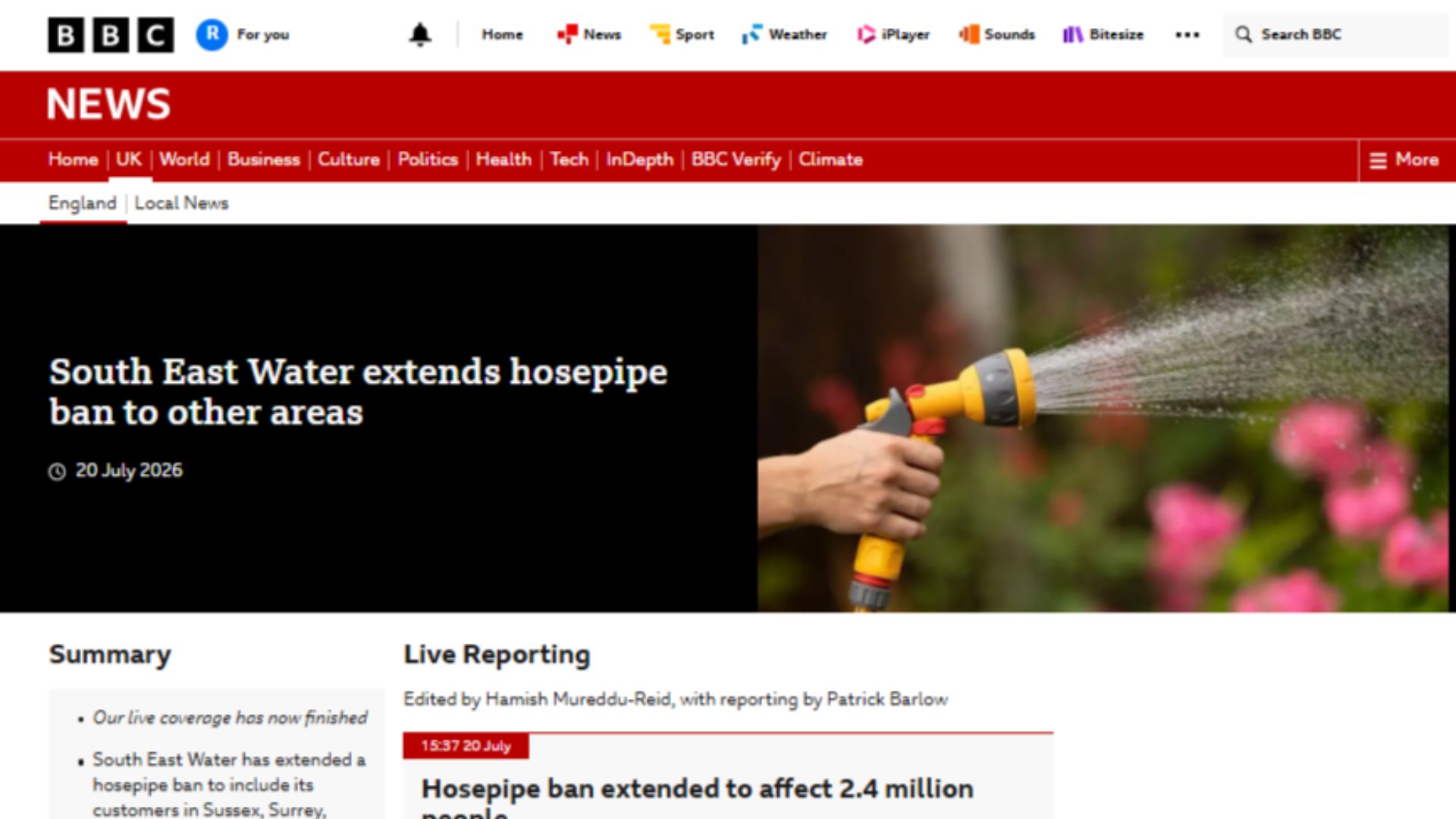
The third, with six drought-related posts, covered rising UK wildfire risk alongside wildfires in France and Spain, citing National Fire Chiefs Council figures on the scale of UK wildfires this year. Climate change was linked to drought repeatedly throughout, making this live blog an exception to the much more limited climate explanation seen elsewhere in the analysis.
What did audiences learn about the drought?
The Environment Agency’s declaration made drought much more visible to audiences, but greater coverage did not necessarily bring greater understanding.
Audiences were most likely to learn that a lack of rain and hot weather were behind the dry conditions. They were much less likely to hear about the role of water management, including leakage and demand, or the longer-term changes needed to make water supplies more resilient.
The same pattern appeared in solutions. Coverage focused heavily on hosepipe bans and personal water-saving advice, while structural responses such as infrastructure investment, leakage reduction and new water sources received much less attention.
Climate context differed between formats. Online articles were more likely than short-form social video to connect drought to climate change and offered a wider range of impacts. Social video increasingly named drought once it was officially declared, but provided less explanation of why it was happening.
Across both formats, drought was also frequently encountered through coverage of heatwaves and wildfires rather than as a story in its own right.
Where audiences got their news also shaped what they learned. An audience relying only on social video would have seen drought named and defined more clearly once it was declared, but had little sense of why it was happening. An audience relying only on online articles would have received more climate context and a wider range of impacts, but was more likely to see drought named without being explained.
Across both formats, this was a missed opportunity. Audiences were told what was happening and what they could do in the short term, but were much less likely to hear why the UK’s water system was under pressure or about the longer-term changes that could make it more resilient.
Methodology
Climate News Tracker analysed drought coverage across online articles, short-form social video, and TV and radio during July 2026.
Across all formats, coverage was classified as linking drought to climate change only where it explicitly connected the drought, the dry conditions contributing to it, or the rainfall deficit to climate change, global warming or human-caused warming. Climate references relating only to other events, such as heatwaves or wildfires, were excluded from this measure and recorded separately.
Online
Coverage was collected from BBC Online, ITV Online, Channel 4 and Sky News from 1 to 31 July. NewsAPI was used for the first three organisations and an in-house automated search for Sky.
Drought-related keywords were used to identify potentially relevant coverage, with each article then manually reviewed. The quantitative analysis included only written news articles primarily focused on drought. Video, audio, live blogs and other formats were excluded and, where relevant, examined separately.
Articles were coded for climate change and fossil fuel links, causes, impacts, adaptation and mitigation responses, and external voices. External voices were recorded only where a named individual appeared.
Social video
We manually reviewed posts published from 1 to 31 July by the main news accounts of BBC News, ITV News, Good Morning Britain, Channel 4 News, Channel 5 News and Sky News on Instagram, TikTok and YouTube Shorts. BBC Weather and ITV Weather were also included on Instagram to compare specialist weather coverage with general news output.
Personal accounts belonging to journalists, presenters and correspondents were excluded to maintain consistency between organisations.
No keyword searches or automated tools were used. A post was included if it focused on drought or dry conditions, including water shortages, lack of rainfall, related extreme weather, public advice, disruption or official warnings. Posts were coded using the same categories as online articles, excluding external voices.
Because online and social video required different collection methods and inclusion criteria, comparisons between them indicate differences in the content audiences encountered rather than like-for-like comparisons of equivalent news items.
TV and radio
TV and radio programmes were searched for drought-related keywords across 20 to 31 July to identify when coverage was most intense. This identified 28 to 31 July as the peak period. All programmes containing at least one drought-related keyword during those four days were then manually reviewed in full.
The monitored sample included: Breakfast, BBC News at One, BBC News at Six, BBC News at Ten, Newsnight, Today, The World at One, PM, The World Tonight, The World This Weekend, Good Morning Britain, ITV Lunchtime News, ITV Evening News, ITV News at Ten, Channel 4 News, 5 News at 5, 5 News Weekend, Breakfast with…, Sky News Today with…, Newshour with…, Broadcasting House, Jeremy Vine, Newsround, Peston, Question Time, Six O’Clock News, Sunday Morning with Trevor Phillips, Sunday with Laura Kuenssberg, The Cathy Newman Show, The World with Yalda Hakim, The Wrap, UK Tonight and Westminster Hour.
Related Insights
Extreme weather brought the fossil fuel transition into UK news, but rarely as the main story
Newsrooms needn’t fear climate is ‘boring’. Audiences don’t think so
Former Head of the BBC Newsroom and Controller of BBC World Service Mary Hockaday argues that extreme weather is giving journalists clear opportunities to explain the climate story, while new audience research suggests the public wants that context. by Mary Hockaday (Former Head of the BBC Newsroom and World Service controller) News crews have been […]
Half the UK public want news reports to explain climate link to extreme weather
As heatwaves, wildfires and drought dominate summer headlines, new Climate News Tracker research finds half the UK public want news organisations to explain the climate link when scientific evidence supports it, while a further 20% want climate change central to every extreme-weather story.

Register here to be the first to receive insights from Climate News Tracker.