CNT Methodology
Climate News Tracker Methodology
This methodology is designed to measure frequency of topic mentions only. It does not assess the quality, prominence, or editorial stance of coverage.
1. Introduction
The Climate News Tracker monitors the alignment between public concern and news coverage on major UK public service broadcasters (PSBs). The aim is to understand whether broadcasters are reflecting national priorities, particularly on climate change.
We focus on eight core topics: the cost of living, the NHS, the economy, crime, international conflict, housing, immigration, and climate change and the environment. The Tracker covers flagship TV and radio news programmes from BBC One, BBC Two, ITV, Channel 4, Channel 5, Sky News, and BBC Radio 4 between 20 September 2023 and 30 March 2025.
Our analysis prioritises UK PSBs because they are required to serve the public interest and reach large, diverse audiences. We also include Sky News, a widely consumed commercial channel with a strong presence in traditional broadcast news. As many news organisations increasingly focus on emerging digital platforms, the Climate News Tracker ensures that traditional audiences, who still rely on TV and radio and number in the millions, are not left behind. By focusing on these established channels, we assess how well legacy news outlets reflect public concern on major national issues. Our approach compares the frequency of issue mentions in news programmes to levels of public concern as measured by the Office for National Statistics (ONS) Opinions and Lifestyle Survey, a 12-day national survey.
2. Measuring Public Concern
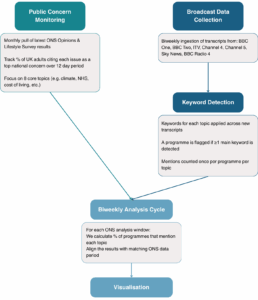
Data Source: Public opinion data is sourced from the ONS Opinions and Lifestyle Survey, which asks a nationally representative sample of UK adults to identify the most important issues facing the country.
Survey Design:
- 12-day collection periods
- Respondents choose up to three issues from a standard list
- Reported as the percentage of people who selected each topic
Topic Selection: We analysed the eight most consistently cited issues in the ONS dataset. These topics form the basis of our comparative analysis.
- Climate change and the environment
- The cost of living
- The NHS
- The economy
- Crime
- International conflict
- Housing
- Immigration
Data Aggregation: Public concern is plotted on a 12 day basis and our broadcast data is aligned to the same calendar periods used in the ONS dataset.
3. Measuring News Coverage
Broadcast Dataset: Programme transcripts were sourced in partnership with the University of Exeter’s Centre for Climate Communication & Data Science (C3DS).
Time Frame: 20 September 2023 – 30 March 2025.
21 Programmes Analysed:
- BBC ONE London: Breakfast, News at One, News at Six, News at Ten
- BBC TWO England: Newsnight
- ITV London: Good Morning Britain, Lunchtime News, Evening News, News at Ten
- Channel 4: Channel 4 News
- Channel 5: 5 News at 5, 5 News Weekend
- Sky News: Breakfast, Sky News Today, News Hour, Sky News at Ten
- BBC Radio 4: Today, World at One, PM, The World Tonight, The World This Weekend
Transcript Quality: Transcripts are machine-generated, which may introduce occasional inaccuracies. Manual reviews were conducted for key term validation. Programme names will vary.
4. Keyword Selection Process
- Topics were based on categories from the Office for National Statistics (ONS).
- Keyword lists were developed through consultation with newsroom professionals, background research, and iterative testing for context and relevance.
- Duplicate and unrelated terms were removed to reduce false positives.
- A programme was counted as covering a topic if at least one relevant keyword appeared in the transcript; repeated mentions within the same programme did not increase the count.
- For clarity, climate change was treated as a separate topic from the environment, reflecting how broadcasters often cover them distinctly.
- In the background we monitor additional relevant keywords to capture any increases in usage or emerging trends.
Keywords tracked:
- Climate Change and the Environment
- Climate
- Climate change, Carbon, Net Zero, Extreme weather, Renewable energy
- Environment
- Environment, Ocean, Environmental, Wildlife, Species
- Climate
- Immigration
- Immigration, Asylum, Refugees, Migrants, Small boats
- Conflict
- War, Israel, Gaza, Ukraine, Russia
- Crime
- Police, Crime, Criminal, Prison, Jail
- Housing
- Housing, Mortgage, Homelessness, Landlord, Rent
- Economy
- Economy, Economic, The Chancellor, Taxes, The Budget
- Cost of Living
- Inflation, Cost of living, Poverty, Energy bills, Rising costs
- NHS
- NHS, Patients, Mental health, GP, Social care
5. Data Processing and Comparison
Temporal Alignment: Public concern (ONS) and broadcast data were aligned to the same 12 day collection windows.
Aggregation Rules:
For each 12 day period:

Programmes were weighted equally; daily and weekly shows were treated with equal consideration.
To compare overall coverage versus concern across the full tracking period (September 2023 to March 2025), we calculate the average percentage of total analysed programmes mentioning a topic and the average percentage of public concern reported by the ONS for that topic.
6. Accuracy and Limitations
To assess the accuracy of automated search results for climate change mentions, we reviewed a random sample of 30 results per broadcaster (5 broadcasters, 150 samples total). For all other topics a random sample of 10 results per topic was checked (70 samples total). Each result was manually checked and classified as either correct (true positive) or incorrect (false positive).
What Counts as an Error
False positives were defined as:
- Transcript errors
- Adverts or sponsorship segments
- Clips outside of the actual programme
- Irrelevant use of keywords (e.g. “net zero migration”)
Error Rate and Confidence
The false positive rate (FPR) was calculated as the proportion of incorrect results in the sample. To account for sampling uncertainty, we calculated the standard error (SE) of the proportion:

Using a 95% confidence level, the margin of error was:
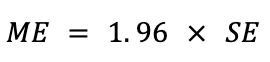
This produced an overall estimated FPR of X% ± Y%.
Adjusting Results
For each time period, the lower and upper FPR bounds were calculated to give a range of possible values per analysed period.
Limitations
- Transcript Inaccuracies: Speech-to-text tools may introduce errors.
- Data Gaps: Some broadcasts may be missing from the archive.
- False Positives/Negatives: Some keywords may be too broad or too narrow.
- Topic Overlap: Themes like economy and cost of living may intersect.
- No Tone or Depth Analysis: Mentions are counted without assessing framing, tone, or narrative context.
Note: This methodology is designed to measure frequency of topic mentions only. It does not assess the intensity, quality, prominence, or editorial stance of coverage.
7. Appendix
🔗 Office for National Statistics (ONS), released 15 August 2025, ONS website, statistical bulletin, Public opinions and social trends, Great Britain: July 2025