UK broadcast coverage shifted sharply towards fossil fuels after the start of the Iran war, with only modest increases in renewable energy reporting and minimal links to climate change.

UK Broadcasters Rarely Link Extreme Weather to Climate Change
Across five UK public service broadcasters, 82% of TV and radio programmes on extreme weather made no mention of climate change during the summers of 2024 and 2025.
by Rosie Frost (Journalism Insights Analyst), Alina Sandauer (Content Analyst) & Dr Lissa O’Reilly (Content Analyst)
March 2026
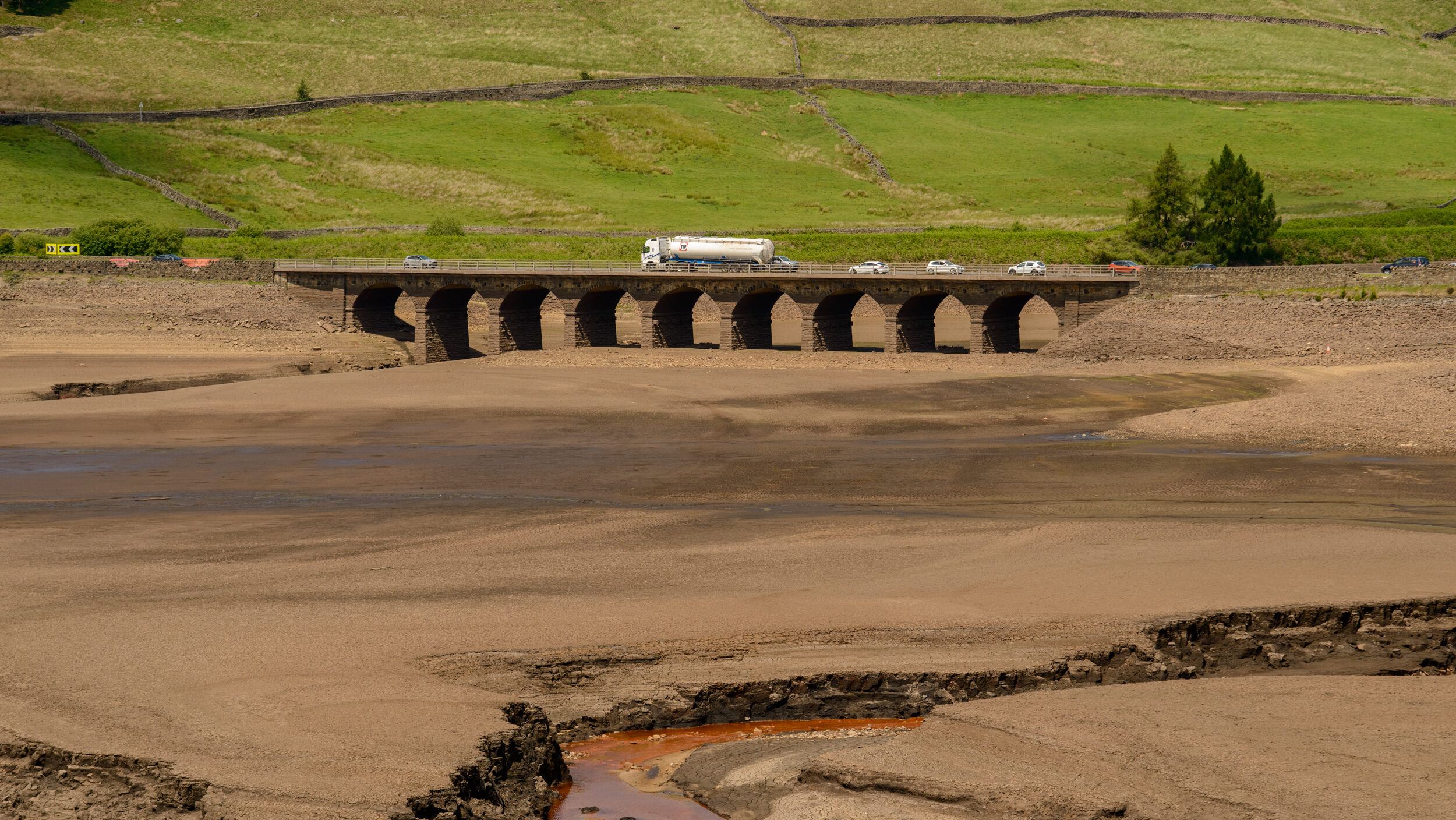
Low water levels in Woodhead Reservoir, Derbyshire in 2025, following the driest spring in England since 1893. Photo: Alastair Johnstone-Hack / Climate Visuals / CC BY-NC-ND 4.0
The UK experienced some of the most dramatic extreme weather in recent memory in 2025, from devastating floods across the north of England to record-breaking summer heatwaves. Yet analysis by Climate News Tracker shows that the majority of broadcast coverage of those events made no mention of climate change.
Attribution science has advanced to the point where researchers can now determine the impact of climate change on individual extreme weather events. The World Weather Attribution (WWA) team at Imperial College London is among the groups leading this work.
So, how often did five of the UK’s public service broadcasters reflect this science in their coverage?
Climate News Tracker’s analysis found that a majority of programmes from the BBC, ITV News, Channel 4, Channel 5, and Sky News covering extreme weather made no mention of climate change in the summers of 2024 and 2025.
Key findings
- 82% of programmes covering extreme weather made no mention of climate change across summer 2024 and 2025.
- In summer 2025, just 22% of extreme weather programmes mentioned climate change. This was a 7 percentage point increase from 14% in 2024, but stories that made this link were still a clear minority.
A persistent gap between extreme weather events and their cause
An analysis of TV and radio programmes from the BBC, ITV News, Channel 4, Channel 5, and Sky News found that 82% of extreme weather coverage made no mention of climate change in Q3 of 2024 and 2025.
During July, August and September of 2025, 22% of programmes covering extreme weather also mentioned climate change. This is a 7-point increase compared to 14% in the same period in 2024.
But the figures may still understate the gap. A programme was counted if climate change was discussed as a broader theme or cause, and direct scientific attribution was not required.
Coverage that meaningfully links events to attribution research, such as WWA’s findings, is likely a smaller share still.
Coverage of flooding included the most mentions of climate change
In 2024, flooding had the highest percentage of coverage mentioning climate change, at 26%. This fell to 19% in 2025.
Heatwaves saw the reverse trend, with coverage mentioning climate change rising from 8% in 2024 to 24% in 2025. WWA guidance for journalists covering extreme weather advises: “Don’t be too cautious—heatwaves are unilaterally linked to global warming”.
Coverage of record temperatures, however, had some of the lowest rates of climate change mentions across the 2 years, at just 1% in 2024 and 2% in 2025. This is a notable gap given the strength of the scientific consensus on the relationship between climate change and temperature records.
Wildfires saw an increase in climate change mentions, rising from 18% in 2024 to 20% in 2025. WWA attributed the fire weather conditions in Spain and Portugal and in Turkey, Greece, and Cyprus, driving Europe’s record 2025 wildfire season directly to climate change.
Hurricane and cyclone coverage had some of the lowest rates of climate change mentions across the sample period.
In 2024, 14% of hurricane coverage mentioned climate change, falling to 1% in 2025. This is despite evidence clearly linking the strength and rapid intensification of storms that happened during this period with climate change.
For example, Hurricane Beryl made landfall in Texas on 8 July 2024, and scientists from Climate Central found that the sea surface temperatures fuelling it were 100–400 times more likely due to climate change. In 2025, Hurricane Erin rapidly intensified from a Category 1 to a Category 5 storm in approximately 24 hours in August, the kind of rapid intensification scientists directly associate with climate-warmed oceans.
Cyclone coverage also saw less than 1% of programmes mention climate change in 2024 and less than 5% in 2025.
Coverage that reflects the science remains the exception
Taken together, the findings suggest that broadcast coverage of extreme weather continues to treat climate change as an optional addition rather than an essential part of the story.
Even with a 7-point improvement year on year, four in five extreme weather programmes still made no mention of it in summer 2025. While attribution science increasingly makes the links between individual events and climate change clear, the gap between what the science shows and what audiences hear on broadcast news remains wide.
Some programmes reviewed as part of the analysis revealed effective strategies for linking extreme weather without lengthy caveats or complex scientific language.
One made effective use of graphics on screen behind the presenter, laying out Met Office findings about summer 2025 being the hottest on record for the UK.
For hurricanes, where attribution can be more complex, other programmes kept it clear and simple by stating that climate change does not cause them, but scientists believe they are now more powerful because of it.
As attribution science continues to advance, examples like these may offer a useful reference point for how the connection between extreme weather and climate change can be communicated clearly and accessibly in broadcast news.
Methodology
The analysis focuses on the third quarter of each year, July to September 2024 and 2025, when extreme weather coverage was most prominent during the summer months.
Transcripts from flagship news programmes across 5 broadcasters (BBC, Sky News, ITV, Channel 4, and Channel 5) covering a range of TV and radio bulletins, including BBC News at Ten, Sky News at Ten, ITV Evening News, and Channel 4 News, were monitored.
To identify relevant coverage, transcripts were searched for extreme weather keywords: cyclones, droughts, floods, heatwaves, hurricanes, wildfires, extreme heat, extreme weather, record temperatures, and rising temperatures. These were then cross-referenced against climate keywords: changing climate, climate change, fossil fuels, global warming, and greenhouse gases. This identified programmes that mentioned both.
Each transcript was then manually reviewed to confirm that the extreme weather and climate references were genuinely linked within the same story, rather than appearing in separate, unrelated segments. Programmes were excluded where the connection was incidental. For example, a story noting that coral reefs have survived cyclones but are being killed by warming sea temperatures driven by climate change would not qualify, as the climate reference is not used to explain the extreme weather event itself.
Full details of the methodology underpinning this tracker are available here.
Related Insights
Iran war coverage dominated by fossil fuels, with climate and renewables getting less attention
Net Zero: Mentioned Often, Explained Rarely
An analysis of early morning and 10pm TV news programmes found that the term “net zero” is routinely reported without explanation or context.
Net Zero Costs and a 1.5°C Near-Miss: How UK Media Covered Two Significant Climate Reports
Two reports with clear news pegs landed in the same week in March 2026. This analysis tracks how they were covered across major UK print, online and broadcast outlets.

Register here to be the first to receive insights from Climate News Tracker.