UK broadcast coverage shifted sharply towards fossil fuels after the start of the Iran war, with only modest increases in renewable energy reporting and minimal links to climate change.

Environmental Risks Continue to Dominate the World Economic Forum’s Long-Term Outlook
Geopolitical and economic shocks are crowding out climate concerns in the near term, but a majority of global leaders still see environmental threats as the most destabilising force shaping the next decade.
by Rosie Frost (Journalism Insights Analysts)
03 March 2026
Environmental risks have slipped down the rankings in the World Economic Forum’s latest Global Risks Report as geoeconomic and political tensions dominate short-term concerns.
It’s a pattern that extends beyond this report and into newsrooms. When geopolitical tensions escalate and economic crises unfold, these stories obviously demand urgent coverage. News about climate change, however, tends to be more reactive, triggered by extreme weather events, major policy announcements, or international summits.
It is a trend that Climate News Tracker’s analysis of UK Public Service Broadcasters (PSBs) shows clearly.
Between September 2023 and March 2025, climate change appeared in only about a third of news programmes, despite nearly six in ten adults considering it one of the country’s most important issues.
The only point when PSB coverage of climate change came close to matching public concern was between 20 September and 1 October 2023. During this short window, mentions of climate reached 58%, almost level with the 62% of adults who saw it as a top national issue at the time. This brief spike in coverage was driven by two major news events: then-Prime Minister Rishi Sunak’s announcement about scaling back key climate pledges and the government’s approval of the Rosebank oil field. Otherwise, coverage remained well below levels of public concern.
While the global leaders and experts believe geopolitical and economic concerns dominate right now, ask them about the next decade and three quarters expect a turbulent or stormy environmental outlook.
This gap between immediate priorities and long-term risks could offer a useful framework for more proactive editorial planning. Though environmental stories may not always drive the daily news cycle, it suggests that they warrant sustained attention alongside more immediate concerns.
Methodology
The Global Risks Report draws on the World Economic Forum’s Global Risks Perception Survey, which has tracked evolving risks for two decades. This year’s survey gathered insights from more than 1,300 global leaders and experts from academia, business, government, international organisations, and civil society between August and September 2025.
Respondents ranked the severity of 33 global risks by severity over one-, two- and 10-year timeframes, considered how risks interact and compound each other, and evaluated which approaches might best drive action on risk reduction.
The survey also asked respondents to predict the outlook for five risk categories – economic, environmental, geopolitical, societal and environmental – using a qualitative scale ranging from calm and stable, through unsettled to turbulent and stormy. This revealed which areas experts expect to face the most challenging conditions in the years ahead.
What does the report tell us about environmental risks?
As short-term concerns overtook long-term objectives, environmental risks moved down the ranking in the WEF’s two-year outlook in 2026.
Extreme weather dropped from 2nd place last year to 4th this year, and pollution from 6th to 9th. Critical change to Earth systems fell 7 positions, and biodiversity loss fell 5. In this year’s report, the severity score of all environmental risks declined, which the WEF says represents an “absolute shift”.
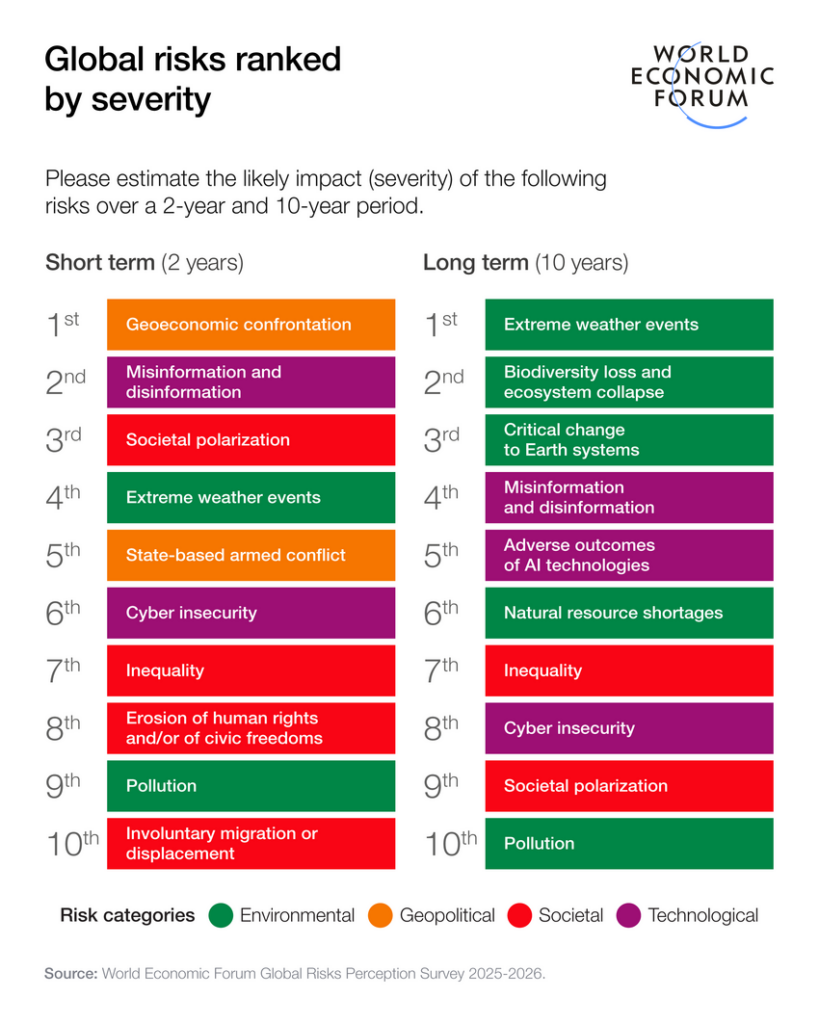
Despite economic and geopolitical crises pushing them off the top spots in the short-term list, environmental risks retained their positions as top risks over the ten-year period. The top three spots on the long-term risk ranking are extreme weather, biodiversity loss and critical change to Earth systems. Natural resource shortages came in 6th and pollution in 10th, meaning that half of the top 10 risks over the next 10 years were environmental.
The report says that the “existential nature of environmental risks” means that they remain a top priority in the long term for all stakeholders and age groups.
A stormy outlook for the environment
This year, the survey also asked respondents about their outlook for the world for each risk category: societal, technological, economic, environmental and geopolitical. They were asked to categorise this outlook on a qualitative scale from calm and stable through unsettled to turbulent and stormy.
Geopolitical risks once again dominated the 2-year outlook. But, over the next 10 years, most respondents were concerned about environmental risks. Nearly three-quarters of those surveyed selected either a turbulent or stormy outlook for this risk category – the highest of all the categories.
Global risks are interconnected
Risks don’t occur in isolation, and the WEF report emphasises that environmental stresses often interact with economic, societal and geopolitical dynamics rather than standing alone. They can aggravate other risk categories, with pressures related to natural resources or biodiversity loss contributing to conflict and economic disruption. Environmental change is, therefore, linked to broader societal and geopolitical instability.
This interconnection suggests that when newsrooms cover resource conflicts, migration, or economic instability without exploring environmental factors, they may be missing part of the story.
While short-term attention has shifted to geopolitical and economic risks, environmental threats have remained the most severe in the long term. It indicates that changes in rankings reflect a shifting focus rather than a reduction in the underlying risks.
Over a ten-year horizon, climate and environmental risks continue to rank among the most severe globally, with impacts that are interconnected, influencing economic, societal, and technological challenges and shaping the broader landscape of global risk.
Sources
World Economic Forum, Global Risks Report 2026, released January 2026
Related Insights
Iran war coverage dominated by fossil fuels, with climate and renewables getting less attention
Net Zero: Mentioned Often, Explained Rarely
An analysis of early morning and 10pm TV news programmes found that the term “net zero” is routinely reported without explanation or context.
UK Broadcasters Rarely Link Extreme Weather to Climate Change
Across five UK public service broadcasters, 82% of TV and radio programmes on extreme weather made no mention of climate change during the summers of 2024 and 2025.

Register here to be the first to receive insights from Climate News Tracker.